
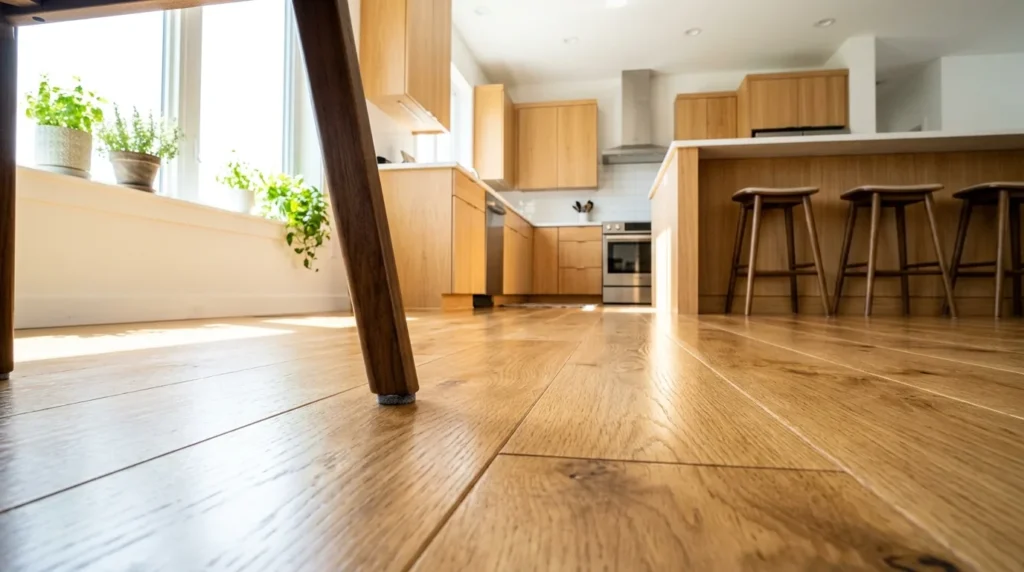
Pre Finished Hardwood Flooring: What It Costs and Whether It’s Right for Your Kitchen
Pre finished hardwood flooring is real wood that comes sanded, stained, and sealed at the factory, so it’s ready to walk on the day it’s installed. If you’ve been staring at flooring samples wondering whether that’s worth the extra upfront cost, you’re not alone. In my own kitchen remodel, the deciding factor wasn’t the look, it was realizing I could have the boards down and the fridge back in place in two days instead of a week.
That speed is exactly why pre finished planks now make up the large majority of hardwood sold in the U.S. But “ready to install” doesn’t mean “right for every kitchen.” Below is what actually matters when you’re comparing it against unfinished wood, tile, or vinyl for a room that sees spills, foot traffic, and the occasional dropped cast iron pan.
What Is Pre Finished Hardwood Flooring, Exactly?
Pre finished hardwood is genuine wood, not a laminate or vinyl look-alike, that’s sanded, stained, and coated with a protective finish in a factory before it ever reaches your home. Unfinished hardwood, by contrast, arrives as raw planks that get sanded and sealed on-site after installation.
Because the finishing happens under controlled temperature and UV curing, manufacturers can apply a more consistent, harder coating than most on-site crews can replicate in a living room. The tradeoff is that each board has a slight beveled edge, so you’ll see a faint groove between planks. It’s a small aesthetic difference most homeowners stop noticing within a week of living with the floor.
Pre Finished vs. Unfinished Hardwood: The Real Differences
Here’s how the two stack up on the things that actually change your day-to-day experience:
| Feature | Pre Finished Hardwood | Unfinished Hardwood |
|---|---|---|
| Installation time | 1 to 2 days, ready to walk on immediately | 3 to 5+ extra days for sanding, staining, curing |
| Dust and fumes | Minimal, finishing already done | Significant on-site sanding dust and VOC odor |
| Finish durability | Factory-cured, often aluminum oxide reinforced | Depends heavily on the installer’s skill |
| Seams | Slight beveled edge visible between boards | Smooth, seamless surface once finished |
| Customization | Fixed factory colors and sheens | Full control over stain color and sheen |
| Typical use case | Busy households, fast turnarounds, rentals | Custom color matching, historic restorations |
If your priority is getting a functional kitchen back fast with minimal disruption, pre finished wins. If you’re matching an existing floor or chasing a very specific stain color, unfinished still has an edge.
How Much Does Pre Finished Hardwood Flooring Cost?
Expect to pay roughly $6 to $20 per square foot installed for pre finished hardwood, with most homeowners landing between $8 and $14 per square foot depending on species, plank width, and region. A 1,000-square-foot kitchen and adjoining living space would run somewhere between $8,000 and $14,000 all in.
A few things push that number up or down:
- Wood species: Oak and hickory sit in the mid-range, while exotic species like Brazilian cherry or teak cost noticeably more.
- Plank width: Wider planks generally command a higher price per square foot than narrow strip flooring.
- Grade: Select-grade boards with fewer knots and color variation cost more than character or rustic grades.
- Subfloor prep: Uneven or moisture-damaged subfloors can add $1 to $5 per square foot before the flooring itself ever gets installed.
Even though pre finished material sometimes costs a bit more per square foot than unfinished wood, the labor savings from skipping on-site sanding and finishing often make the total project cost comparable, and sometimes lower.
Is Pre Finished Hardwood Flooring a Good Choice for a Kitchen?
Yes, with a caveat: engineered pre finished hardwood generally handles a kitchen’s moisture swings better than solid pre finished planks. Kitchens deal with more temperature and humidity fluctuation than any other room besides the bathroom, and engineered construction resists that expansion and contraction more reliably.
If you love the idea of solid pre finished planks, you can still use them successfully in a kitchen. Just commit to a few habits: wipe up spills immediately, keep a mat or rug near the sink and dishwasher, and use felt pads under chair and appliance legs. Homeowners who’ve lived with pre finished hardwood in the kitchen for years generally report that the factory finish resists staining and everyday spills better than they expected, as long as water isn’t left sitting.
Benefits of Pre Finished Hardwood Flooring
Faster installation with less disruption. Because the boards arrive fully cured, there’s no waiting for stain and topcoat to dry. Most rooms are installed and walkable within a day or two, which matters a lot when the room in question is your only kitchen.
A cleaner, healthier install. All the sanding and finishing happens at the factory, not in your house. That means no dust settling into cabinets and countertops, and none of the strong solvent smell that lingers for days after an on-site finish job.
Tougher, more consistent protection. Many pre finished floors use aluminum oxide-reinforced topcoats cured under UV light, which creates a harder, more scratch-resistant surface than most site-applied polyurethane. The factory setting also means every plank gets the same number of coats at the same thickness, so you don’t end up with the uneven sheen that can happen with hand-applied finishes.
Lower long-term maintenance. A harder factory finish means less frequent refinishing and easier day-to-day cleaning, which is worth a lot in a room where you’re sweeping up crumbs daily anyway.
Drawbacks Worth Knowing Before You Buy
Higher upfront material cost. Pre finished planks typically cost more per square foot than raw, unfinished wood, even though labor savings often close the gap.
Visible seams. The micro-bevel between boards is a style choice some homeowners love for the definition it gives each plank, and others find slightly less seamless than a site-finished floor.
Harder to match existing floors. If you’re extending hardwood from an adjoining room, matching an old on-site stain color to a new pre finished product can be tricky, since factory colors are fixed.
Limited on-site color changes. What you see in the box is what you get. There’s no changing your mind about stain shade once it’s installed, the way you could with unfinished planks.
Solid vs. Engineered Pre Finished Hardwood
Solid pre finished hardwood is milled from a single piece of wood, typically around ¾ inch thick, and can be sanded and refinished multiple times over a lifespan that can stretch 50 years or more. Engineered pre finished hardwood has a real hardwood wear layer bonded over layers of plywood or high-density fiberboard, which makes it more dimensionally stable in humidity and suitable over concrete slabs or radiant heat.
For kitchens specifically, engineered construction is usually the safer bet because it resists the swelling and gapping that humidity swings can cause in solid wood. If refinishing potential matters to you long-term, look for engineered products with a wear layer of at least 2.5mm, often labeled “certified refinishable,” since a thin wear layer can only be recoated, not sanded.
How Long Does Pre Finished Hardwood Flooring Last?
Most pre finished hardwood floors last 25 to 30 years with normal care, and some manufacturers back solid pre finished collections with lifetime warranties. Longevity comes down to three things: the wood species you chose, the quality of the factory finish, and how consistently you keep up with basic maintenance like sweeping and wiping spills.
A few habits stretch that lifespan even further:
- Use felt pads on furniture and appliance legs
- Sweep or vacuum regularly to keep grit from scratching the finish
- Place rugs or mats in high-traffic zones and near water sources
- Keep pet nails trimmed to avoid surface scratches
Can you refinish pre finished hardwood floors?
Yes, most solid pre finished hardwood can be sanded and refinished, though the tough factory coating makes the first sanding pass more labor-intensive than with a site-finished floor. Engineered pre finished hardwood can only be refinished if the wear layer is thick enough, generally 2.5mm or more; thinner wear layers can be recoated but not sanded.
Is pre finished hardwood more scratch resistant than unfinished?
Generally yes. Most pre finished floors use an aluminum oxide-reinforced topcoat cured under UV light, which creates one of the harder, more wear-resistant surfaces available for wood flooring. No hardwood is scratch-proof, though, so pads, rugs, and regular maintenance still matter.
Does pre finished hardwood cost more than unfinished?
The material itself often costs somewhat more per square foot, but unfinished hardwood adds separate labor costs for on-site sanding, staining, and sealing that can run an extra $1.50 to $5 per square foot. Total installed costs for both options frequently land in a similar range.
What’s the best wood species for pre finished kitchen flooring?
Oak, particularly white oak, remains the most popular choice for kitchens because its tight grain resists moisture better than softer species and its neutral tone works with most kitchen palettes. Hickory is a close second for households wanting extra hardness in a high-traffic room.
Is Pre Finished Hardwood Worth It?
For most homeowners, yes. Pre finished hardwood flooring delivers a faster, cleaner installation and a more durable factory finish than on-site sanding and staining typically achieves, and the total installed cost is often comparable to unfinished wood once labor is factored in. It’s the practical choice unless you need to match an existing custom stain or want full control over the final sheen.

Pingback: refinish hardwood floors cost in 2026 (Full Guide)