German Chocolate Cake Recipe
Ingredients
Instructions
German Chocolate Cake Recipe: Three Moist Layers With Coconut Pecan Frosting
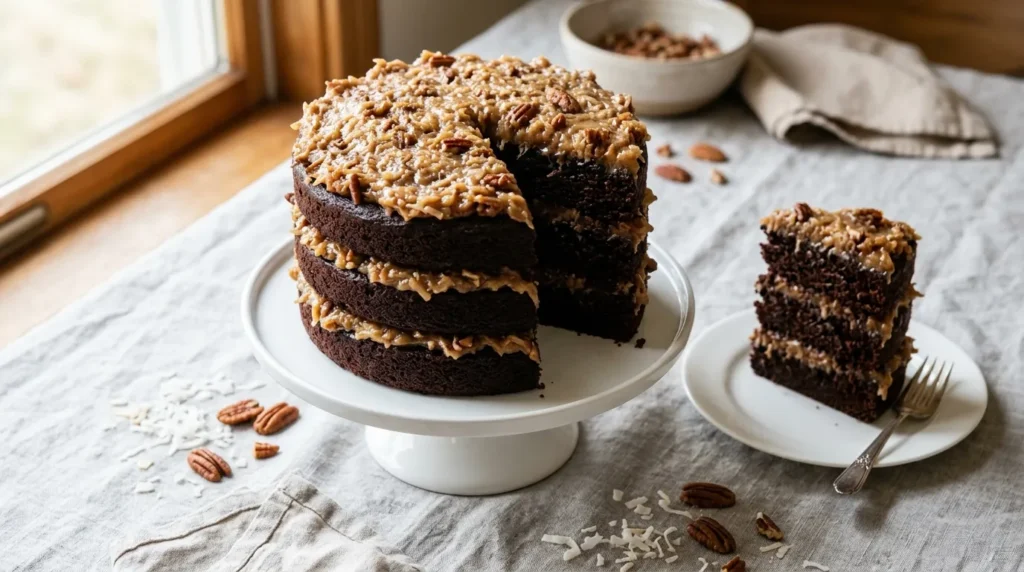
This German chocolate cake recipe gives you three tender chocolate layers, a gooey coconut pecan filling, and bare sides that show off every layer. It follows the classic Baker’s German’s style, made from scratch with buttermilk and whipped egg whites, and it is friendlier than it looks. Plan on about two hours and forty-five minutes, most of it cooling time, and you end up with the cake people request for birthdays, Easter, and Christmas dinner.
Anyone hunting for the best German chocolate cake recipe usually wants the same things: a soft, moist crumb, a frosting that actually sets, and steps that do not fall apart halfway through. Below you will find what makes this cake different, notes on every ingredient, a clear walkthrough, frosting fixes, swaps, and storage advice. The recipe card on this page lets you tick off each ingredient and step as you bake.
What Is German Chocolate Cake?
German chocolate cake is a mild chocolate layer cake filled and topped with a cooked coconut pecan frosting. It is an American cake, not a German one. The name comes from Samuel German, a baker who developed a sweet baking chocolate for Baker’s Chocolate Company in 1852.
A Texas homemaker sent a cake made with that chocolate to a Dallas newspaper in 1957, and the recipe spread across the country from there. Over time the possessive dropped off, and “German’s chocolate cake” became German chocolate cake.
Two things set it apart from a standard chocolate cake. The layers are lighter in color and gentler in flavor than devil’s food, because sweet baking chocolate is milder than semi-sweet or bittersweet. The frosting is a custard of egg yolks, evaporated milk, sugar, and butter, cooked on the stove and packed with flaked coconut and toasted pecans. It is meant to be gooey and spoonable, never stiff like buttercream.
German Chocolate Cake Recipe Ingredients
Most German chocolate cake recipes use the same short list, but a few ingredients carry more weight than the rest. Here is what each one does and what you can swap.
Sweet baking chocolate. Look for a bar labeled German’s sweet chocolate in the baking aisle. It melts into the batter and gives the cake its signature flavor. If you cannot find it, semi-sweet baking chocolate works. The cake will taste a little less sweet, and that is fine.
Buttermilk. It adds tang, tenderizes the crumb, and deepens the color. No buttermilk in the fridge? Stir one tablespoon of lemon juice or white vinegar into one cup of milk, wait five minutes, and use that.
Eggs. The yolks go into the batter and the frosting. The whites get whipped to stiff peaks and folded in, which is what makes the cake so light. Cold eggs separate more cleanly, but let the whites sit out for a few minutes before whipping so they gain more volume. Crack each egg over a small bowl first, because one speck of yolk in the whites keeps them from whipping fully.
Flour. All-purpose flour gives a sturdy crumb that holds up to stacking. For a softer, finer crumb, use cake flour instead (2 1/2 cups replaces the 2 1/4 cups of all-purpose).
Butter. Use unsalted butter, softened until a finger leaves a dent without sinking straight through. Butter that is too warm turns the creamed mixture greasy.
Evaporated milk. This is for the frosting. Do not swap in sweetened condensed milk, which makes the frosting far too sweet and changes how it sets.
Coconut and pecans. Sweetened flaked coconut gives the frosting its chew. Toast the pecans for 6 to 8 minutes in a 350°F oven, or in a dry skillet, until they smell nutty. Toasting keeps them crunchy even inside the gooey frosting.
How to Make German Chocolate Cake
Read through the steps once before you start. The order matters more here than in most layer cakes.
Prep the pans. Grease three 8-inch round pans, line the bottoms with parchment, and grease the parchment lightly. Two 9-inch pans also work, and those layers bake a few minutes faster.
Melt the chocolate. Pour boiling water over the chopped chocolate and stir until glossy and smooth. Let it cool to lukewarm. Hot chocolate can scramble the yolks when it hits the batter.
Cream the butter and sugar. Beat them for a full three to four minutes, until pale and fluffy. This step builds a lot of the cake’s lift. Add the yolks one at a time, then the vanilla and the cooled chocolate.
Alternate flour and buttermilk. Add the dry ingredients in three parts and the buttermilk in two, starting and ending with flour. Mix on low, and stop as soon as you no longer see dry streaks. Overmixing builds gluten and gives you a tough cake.
Whip and fold the whites. Use a clean, grease-free bowl. Beat the whites until the peaks stand straight up when you lift the beaters. Fold in about a third to loosen the batter, then fold in the rest by cutting down through the middle, sweeping along the bottom, and lifting up and over. Stop when the white streaks disappear.
Bake. Divide the batter evenly among the pans and smooth the tops. Bake at 350°F for 35 to 40 minutes, until a toothpick in the center comes out clean. The top may look a little flat and crackly. That is normal for this cake.
Cool completely. Leave the layers in the pans for 10 minutes, turn them out onto wire racks, and let them cool for about an hour. Frosting a warm layer makes the filling slide right off.
Cook the frosting while the cakes cool. Whisk the evaporated milk, brown sugar, yolks, butter, and salt in a saucepan before you turn on the heat. Cook over medium heat, stirring constantly, for 10 to 12 minutes, until thick and bubbly. Off the heat, stir in the vanilla, coconut, and pecans, then let it cool for about 30 minutes.
Assemble. Set the first layer on a plate and spread a third of the frosting all the way to the edge. Repeat with the second layer, then top with the last layer and the rest of the frosting. Leave the sides bare, which is the traditional look. Slice with a sharp knife and wipe it clean between cuts.
Frosting Tips and Common Mistakes
The frosting is why most people search for a German chocolate cake frosting recipe in the first place, so it deserves the most attention.
- Whisk cold, then heat. Combining the yolks, milk, and sugar before the pan is warm keeps the yolks from scrambling.
- Keep the heat at medium. High heat curdles the custard. You want a slow, steady thickening, and a spoon dragged across the bottom of the pan should leave a clear trail.
- Judge it after cooling. The frosting looks thin while hot and thickens a lot as it cools. Stir it every few minutes while it sits.
- Strain if you see lumps. If a few bits of cooked egg show up, push the custard through a fine-mesh sieve before adding the coconut and pecans.
- Skip the fridge shortcut. Chilling the frosting to speed things up makes it stiff and hard to spread.
A few cake mistakes come up again and again. Overbaking dries out the layers, so start checking at 35 minutes. Unequal layers bake unevenly, so weigh or eyeball the batter carefully. Underwhipped egg whites give a dense cake. And frosting a warm layer, as noted above, ruins the neat stack.
Variations and Substitutions
This cake is flexible once you know how the pieces work.
- Sheet cake. Bake the batter in a 9 x 13-inch pan at 350°F until a toothpick comes out clean. Spread all the frosting across the top.
- Cupcakes. Fill liners about two-thirds full and bake until a toothpick comes out clean, usually around 18 to 22 minutes. Top each one with a spoonful of frosting.
- Different nuts. Walnuts, almonds, or macadamia nuts all work in place of pecans.
- Nut-free. Leave out the pecans and add a little extra toasted coconut for texture.
- Chocolate on the outside. Some bakers wrap the cake in chocolate buttercream or ganache, which keeps the sides moist and makes cleaner slices.
- Less sweet frosting. Food Network’s test kitchen liked dulce de leche buttercream as an alternative for people who find the classic filling too sweet.
- Two layers. Bake in two 9-inch pans and split the frosting between them.
Storage and Make-Ahead Tips
Because the frosting contains eggs and dairy, keep the finished cake in the refrigerator. The bare sides dry out quickly, so wrap the cake snugly in plastic or store it under a tight cover. It keeps well for three to four days.
Cold cake tastes dull and a bit dry. Take a slice or the whole cake out 30 to 45 minutes before serving so the frosting softens and the crumb relaxes.
To bake ahead, cool the layers completely, wrap them tightly, and keep them at room temperature overnight. Make the frosting the same day or a day early, refrigerate it, and let it come back to room temperature before spreading. Assemble the day you plan to serve for the best texture.
To freeze, chill the assembled cake until the frosting firms up, then wrap it well in plastic and foil. It holds for up to three months. Thaw it overnight in the refrigerator, still wrapped. Individual slices, wrapped one by one, thaw faster and work well for a single serving. A cup of coffee or a scoop of vanilla ice cream goes nicely alongside.
Frequently Asked Questions
Why is it called German chocolate cake?
The name comes from Samuel German, who created German’s sweet baking chocolate in 1852. The cake was first published in a Dallas newspaper in 1957 using that chocolate, so the name refers to a person and a product, not the country.
Does German chocolate cake need to be refrigerated?
Yes. The frosting is made with eggs and evaporated milk, so the cake should go in the refrigerator once it has sat out for about two hours. Bring it to room temperature for 30 to 45 minutes before you slice it.
Why is my German chocolate cake frosting runny?
Most often the custard was not cooked long enough for the yolks to set. Return it to low heat and stir for a few more minutes until thick and bubbly. If it is only slightly loose after cooling, stir in a little extra coconut to absorb the moisture.
Can I use regular chocolate instead of German chocolate?
You can. Semi-sweet baking chocolate is the closest swap. The cake will taste a bit less sweet and slightly darker, but the texture stays the same.
If you bake this German chocolate cake recipe, leave a comment and let us know how your layers and frosting turned out. For more cake ideas, browse the rest of the Kitchennista recipes.