

Can You Freeze Cooked Rice Safely?
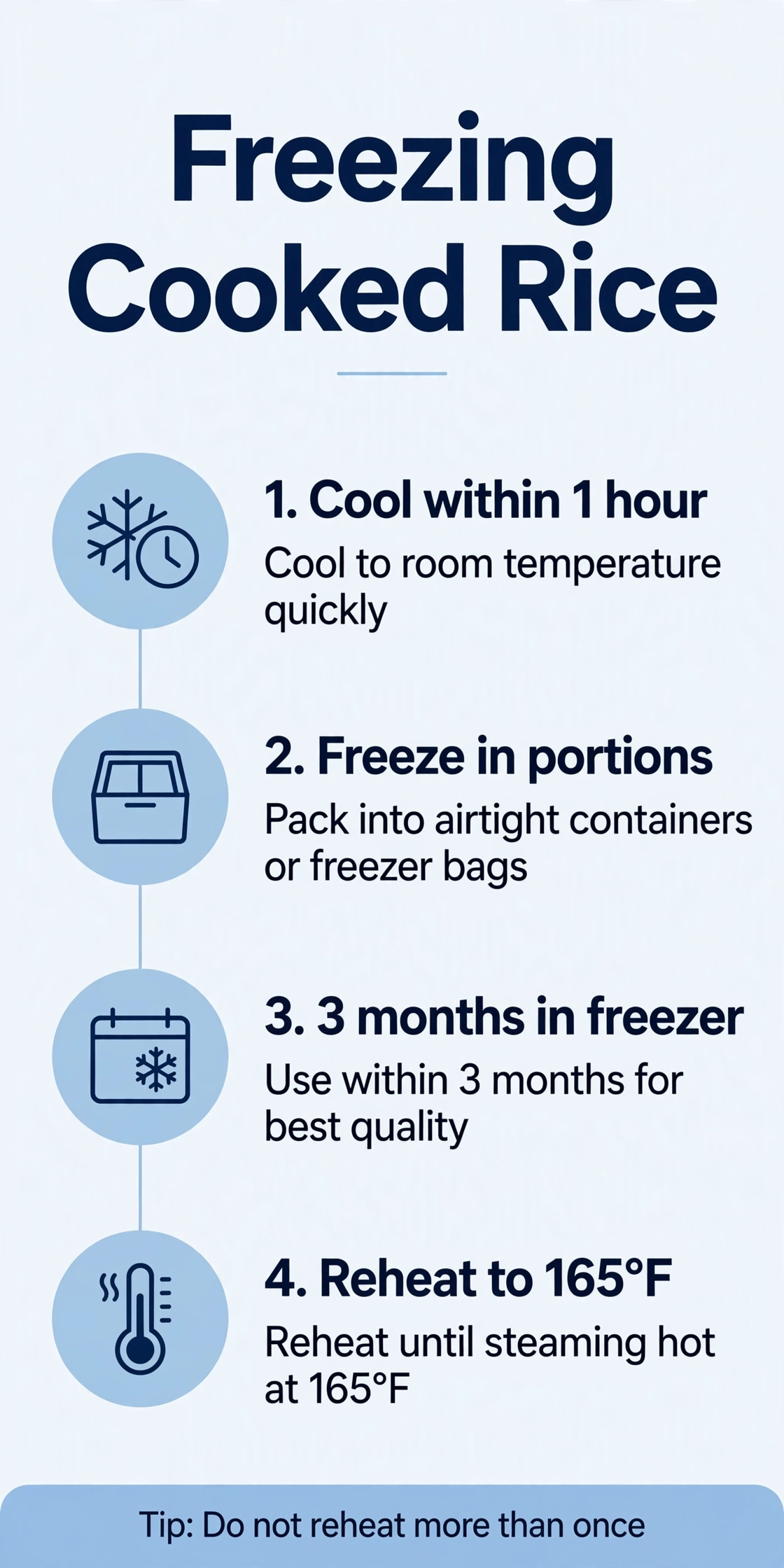
Yes, you can freeze cooked rice, and most food guides say it keeps for up to 3 months. The trick is cooling it fast. Get it into the freezer within an hour of cooking, pack it flat in portions, and reheat it to 165°F. Freezing does not kill the bacteria that grow in rice left out too long.
There is always too much rice. You cook for four, two people show up, and the leftovers sit in the fridge until they dry out and go in the bin. Freezing fixes that, but only if you do it right. Rice has its own risk, and most guides online either skip it or disagree about it. One says three months. Another says six.
Why rice is different: Bacillus cereus in plain English
Uncooked rice can carry tiny spores from a bacterium called Bacillus cereus. Cooking does not kill them. The spores survive the heat, and they just sit there, harmless, as long as the rice stays hot or gets cold fast. The problem starts when cooked rice sits at room temperature. Between about 40°F and 140°F, the spores wake up and grow, and as they grow they can make toxins. Reheating does not destroy those toxins. You can microwave the rice until it is steaming and the toxins can still be there. That is why cooling matters more than freezing. Freezing stops the bacteria from growing, but it does not kill the spores or remove toxins that already formed. If the rice sat out for four hours before you froze it, the freezer does not undo that. None of this means cooked rice is dangerous. It means the rules for it are stricter than the rules for, say, leftover pasta. Cool it fast, freeze it fast, reheat it once, and you are fine.
Cool it within 1 hour
This is the one rule to take seriously. Cooked rice should go from the pot to the fridge or freezer within an hour. Food safety guidance usually allows two hours for most cooked food, but rice gets the shorter window because of the spores. If the room is hot, above 90°F, that window shrinks further. Spread the rice out. A deep pot of hot rice cools slowly in the middle, and the middle is where the bacteria grow. Tip it onto a baking sheet in a thin layer and let the steam escape for 10 to 15 minutes. You want it to stop steaming before you pack it up. Trapped steam means condensation, and condensation means wet rice that clumps into a brick in the freezer. Do not leave the pot on the stove while you eat dinner. Pack it up first, then sit down to eat.
How to freeze cooked rice
Once the rice is cool, the method is simple. The goal is flat, thin portions that freeze fast and thaw fast.
Portion it first
Freeze rice in the amounts you actually eat. One or two cups per bag is about right for most people. Freeze the whole pot in one container and you have to thaw all of it to use any of it, and you cannot refreeze what is left. Small portions also freeze faster, which means less time in the temperature range where bacteria grow.
Flatten the bags
Freezer bags work better than containers here. Spoon a portion into a bag, press out as much air as you can, and flatten it to about half an inch thick. Lay the bags flat in the freezer until they are solid, then stack them upright like files. Flat bags thaw in minutes. A thick block takes much longer, and the outside can go warm while the middle is still frozen. If you would rather use containers, pick shallow ones with lids that actually seal. Leave a little space at the top because rice expands slightly as it freezes. Do not use a container with a loose lid. Freezer burn shows up fast on rice that is not sealed well.
Label everything
Write the date and the kind of rice on every bag. Without a date, a bag from last month and a bag from last week look exactly the same, and you will guess wrong. A permanent marker on the bag works. Masking tape on a container works too.
How long does cooked rice last in the freezer?
Most food guides say up to 3 months. Taste of Home (September 2024) and Love Food Hate Waste (September 2022) both use 3 months, and that is the number this guide uses. One small blog, Wellstockd (August 2026), says 6 months, which conflicts with the 3-month figure. There is no verified USDA figure for cooked rice in the freezer that could be confirmed while writing this article, so 3 months is labeled here as the consensus from most food guides, not as a USDA number. Three months is about quality as much as safety. Rice frozen for a month still tastes close to fresh with a splash of water. Rice frozen for five or six months is safe if it stayed frozen, but it will be drier and can taste stale. Freezer burn shows up as dry, pale patches, a sign the bag was not sealed well. In the fridge, cooked rice lasts a shorter time. Most food guides give it 3 to 4 days, shorter than cooked quinoa, which most guides give 3 to 7 days. For the quinoa version of this, see “How long does cooked quinoa last in the fridge“.
How to thaw and reheat safely
Thawing is where most people go wrong. The safe ways are slow or fast, but not in between. The easiest way is overnight in the fridge. Move a bag over the night before and it is thawed and cold by morning. If you are short on time, reheat it straight from frozen. Put the rice in a microwave-safe bowl, add a tablespoon or two of water per cup, cover it with a damp paper towel or a loose lid, and heat in short bursts. Stir between bursts so it heats evenly. A frozen flat bag thaws in the microwave in about two to three minutes. On the stove, break the frozen block into a pan with a splash of water, cover it, and heat it over medium-low heat. Stir it now and then until it is hot all the way through. Whatever method you use, the target is the same: 165°F, steaming hot all the way through. Do not just warm the outside and call it done. Stir it, check the middle, and heat it again if there are cold spots. The rice should be steaming throughout and too hot to eat right away. Do not thaw rice on the counter for hours, and do not thaw it in hot water in the sink. Both put the outside in the temperature range where the spores grow while the inside is still frozen. For the microwave method in full, see our guide on can you reheat rice in the microwave safely.
Which rice freezes best
Not all rice freezes the same. The starchier the rice, the more it changes after freezing. White rice freezes best. Long-grain white rice holds its shape, reheats well, and tastes close to fresh for the full three months. Jasmine rice is nearly as good. It is softer and more fragrant than plain long-grain, and it reheats well with a splash of water. The aroma fades a bit after a month or two, but the texture holds up. Basmati rice freezes well too, as long as you do not overcook it first. Basmati cooked until just tender comes back nicely. Basmati that was already soft turns mushy. Brown rice is the trickiest of the plain rices. Freezing makes it a little drier, so it needs more water when you reheat it, and it is best used within a month or two rather than the full three. Fried rice is better eaten fresh. The vegetables soften and the egg goes rubbery if it is reheated too hard. If you do freeze it, reheat it gently in a pan rather than blasting it in the microwave.
How many times can you reheat rice?
Once. That is the rule, and it is worth following. Every time rice cools down and warms up again, it spends more time in the temperature range where Bacillus cereus grows. Reheating to 165°F kills the growing bacteria, but it does not destroy the toxins they may have made while the rice was cooling. So the risk goes up with every cycle, even if the rice smells fine. The fix is portions. Freeze rice in one-meal amounts and thaw only what you need. If you reheat a big bowl and only eat half, the rest should go in the bin, not back in the fridge.
FAQs
Is it safe to freeze cooked rice?
Yes, as long as you cool it fast and freeze it within an hour of cooking. Freezing stops bacteria from growing, but it does not kill the spores or remove toxins that formed while the rice sat out warm.
How long can you keep cooked rice in the freezer?
Most food guides say up to 3 months. One small blog says 6 months, but that conflicts with the 3-month figure used by Taste of Home and Love Food Hate Waste. Quality drops after a few months even when the rice stays safe, so it tastes best in the first month or two.
Does freezing kill Bacillus cereus?
No. Freezing does not kill Bacillus cereus spores, and it does not destroy the toxins the bacteria can make. Freezing only pauses the growth. That is why cooling the rice within an hour matters so much. The freezer cannot fix rice that already sat out too long.
Can you freeze rice after 2 days in the fridge?
You can, but it is not a good idea. Rice that has been in the fridge for two days is already halfway through its fridge life, and freezing it does not reset the clock. Freeze rice on the day you cook it.
Can you freeze cooked rice in containers?
Yes. Shallow containers with lids that seal well work fine, with a little space at the top for expansion. Freezer bags are usually better because you can flatten them and stack them, but containers are fine too.
Does frozen rice taste the same as fresh?
Close, but not identical. Rice reheated with a splash of water tastes nearly fresh for the first month or two, then gets a little drier and firmer. White and jasmine rice hold up best.
Can you freeze rice with sauce on it?
Yes, and it often freezes better than plain rice because the sauce keeps it moist. Rice in a curry or a saucy stir fry freezes well in portions. Cream sauces are the exception. They can split when they thaw and come back grainy.
The bottom line
Freezing cooked rice is worth doing. Cool it fast, pack it flat in portions, label it, and use it within 3 months. Thaw it in the fridge or reheat it straight from frozen to 165°F. Reheat it once, and only thaw what you need.
The same thinking applies to other leftovers. For how long cooked food keeps in the fridge, see “How long is cooked steak good for in the fridge” — and “How long can steak stay in the fridge“. For cooked quinoa, which keeps a little longer than rice, see “How long does cooked quinoa last in the fridge“. And if you want to know whether cream cheese survives the freezer, see “Can you freeze cream cheese“.
More kitchen guides: How to Keep Cilantro Fresh in the Fridge Longer, How to Clean a Burnt Pan Without Baking Soda, How to Soften Brown Sugar Quickly (No Microwave), How to Stop Pasta Sticking After Draining

Sufyan Liaqat writes kitchen recipes, guides, and food content for Kitchennista. He focuses on practical advice that helps readers cook with confidence at home. His work covers everyday recipes and useful kitchen ideas.


Pingback: Can You Reheat Rice in the Microwave Safely?