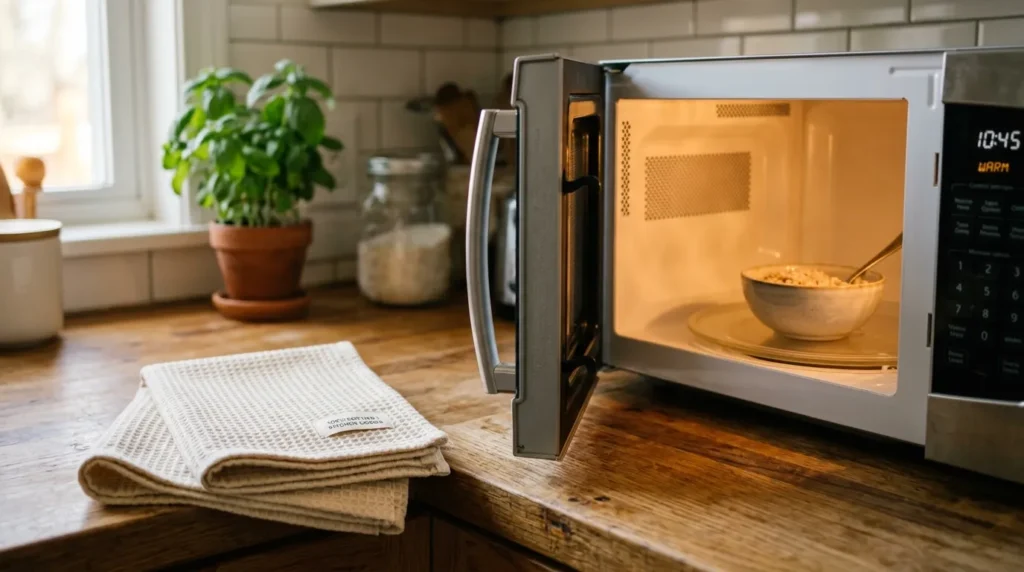
If you’re standing in the kitchen wondering “can you put kitchen towel in the microwave,” the short answer is yes, but only under specific conditions, and the fabric matters more than most people realize. A damp, all-cotton towel can go in for short bursts to steam food or soften stuck-on grime. A dry towel, a microfiber towel, or one with metallic thread trim should stay out entirely, because those are the exact conditions that start kitchen fires. This guide breaks down which towels are safe, how long to run them, and the one popular “hack” involving kitchen towels that fire departments actively warn against.
It Depends on the Fabric and How Wet It Is
If you only read one section, read this one. A kitchen towel is generally microwave-safe when it is made of 100% cotton, thoroughly dampened with water, free of any metallic thread or foil-printed decoration, and heated in short 15-to-30-second bursts rather than one long cycle. Under those conditions, a towel behaves a lot like a wet paper towel: the moisture absorbs the microwave energy and keeps the fabric from scorching. Skip any one of those conditions and the towel becomes a genuine fire risk, not just a theoretical one.
Not Every Kitchen Towel Is the Same Material
“Kitchen towel” covers a wider range of fabric than people assume, and each one reacts to microwave heat differently.
- Cotton towels. The classic dish towel or tea towel. Cotton is a natural, absorbent fiber that handles microwave heat reasonably well when damp, but it is flammable once it dries out, which can happen surprisingly fast under direct microwave energy.
- Linen towels. Similar profile to cotton: natural fiber, absorbent, safe when wet, risky when dry.
- Microfiber towels. These are synthetic, usually a polyester-nylon blend, and they are the ones you want to keep out of the microwave altogether. Synthetic fibers can scorch, melt, or release fumes well before they’d catch open flame, and melted plastic fibers are much harder to deal with than a singed cotton towel.
- Paper towels. Not a “kitchen towel” in the fabric sense, but worth a quick mention since the two get lumped together in searches. Plain white paper towels, free of dye or printing, are generally microwave-safe in short intervals too, for the same moisture-based reason.
If you’re not sure what your towel is made of, check the care label. A blend that includes any percentage of polyester or nylon should be treated like microfiber for microwave purposes, not like cotton.
Wattage matters here too, and it’s an easy factor to overlook. A 1,000-watt microwave heats a damp towel faster than a 700-watt one, so the “15 to 30 seconds” guideline below is really a starting point, not a fixed rule. Run your first attempt on the shorter end and adjust from there once you know how your own microwave behaves.
Why People Put a Dish Towel in the Microwave
There are a few legitimate reasons this comes up in the kitchen, beyond curiosity:
- Steaming bread, tortillas, or rice. Wrapping food in a damp towel before a short microwave burst traps steam and keeps it from drying out, similar to how a restaurant keeps tortillas warm.
- Loosening stuck-on food or grease. A damp towel heated for 15 to 20 seconds becomes an easy way to wipe down a stovetop or cutting board without scrubbing.
- Covering a dish to stop splatter. Some people reach for a kitchen towel instead of plastic wrap or a paper towel to keep sauce from spattering the microwave’s interior.
- Warming a towel for a compress. Not food-related, but common enough to mention: a damp towel heated briefly is sometimes used as a warm compress. The same fabric and timing rules apply, and you should always test the temperature against your wrist before applying it to skin.
All four uses are reasonable, as long as the towel itself follows the safety rules in the next section. Home cooks who reach for a towel out of habit, the way they might grab a paper towel without thinking, are usually the ones who run into trouble, simply because they skip the “is this actually damp enough” check.
How to Put a Kitchen Towel in the Microwave Safely
If you’re going to do this, treat it the same way you’d treat any improvised microwave item: cautiously and briefly.
- Confirm it’s 100% cotton or linen, with no metallic thread, foil print, or synthetic trim.
- Soak it thoroughly, then wring out the excess so it’s damp, not dripping. A bone-dry towel is the single biggest cause of microwave fires involving fabric.
- Lay it flat, not folded or bunched, so heat spreads evenly instead of concentrating in one thick section.
- Heat in 15-to-30-second bursts, checking the towel’s temperature and moisture level between each one.
- Never leave the microwave unattended while a towel is inside, even for a “quick” cycle.
- Use oven mitts or tongs to remove it. A towel that’s been steaming can hold as much heat as the dish it was covering.
Skipping any single step in that list is what turns a routine kitchen habit into a fire hazard.
The Sponge-and-Towel “Disinfecting” Trick Fire Departments Warn Against
Here’s something most articles on this topic skip entirely: there’s a well-known claim, based on a 2007 study published in the Journal of Environmental Health, that microwaving a damp dishcloth or sponge for two minutes kills 99% of the bacteria living in it, including E. coli and salmonella. It’s a real study, and the science behind it holds up under lab conditions.
The problem is what happens outside a lab. Fire departments, including UK regional services, have issued public warnings after responding to real kitchen fires caused by people trying this at home, usually because the cloth wasn’t wet enough or the microwave ran longer than the study’s controlled two minutes. A damp dishcloth that dries out partway through a longer cycle can ignite well before the timer ends.
If bacteria buildup is the actual concern, replacing dishcloths and towels regularly, and washing them on a hot cycle, gets you most of the same benefit without turning your microwave into an ignition source.
When You Should Never Microwave a Kitchen Towel
Skip the microwave entirely if any of the following apply:
- The towel is dry. No moisture means nothing to absorb the microwave energy, so the fabric heats directly and can scorch or ignite.
- It contains microfiber, polyester, or nylon. These synthetic fibers can melt at temperatures a standard microwave reaches in under a minute.
- It has metallic thread, foil print, or a decorative metallic trim. Metal in a microwave causes arcing, which is a genuine spark-and-fire risk regardless of the fabric underneath it.
- It’s soaked in oil or grease. Oily fabric heats unevenly and can reach flashpoint faster than a plain damp towel.
- You plan to run it for more than a minute at a time. Long, uninterrupted cycles are where most towel-related microwave fires start.
What to Do If a Towel Starts Smoking in the Microwave
If you see smoke, sparking, or a flame:
- Keep the microwave door shut. Opening it feeds the fire more oxygen.
- Turn the microwave off or unplug it at the wall if it’s safe to reach.
- Let it sit closed until the smoke or flame has fully died down, then ventilate the kitchen.
- Don’t use the microwave again until it’s been checked, since scorching or arcing can damage the interior lining.
A closed, powered-off microwave will usually smother a small fabric fire on its own within a minute or two, since there’s no fresh air feeding it.
How long can you microwave a wet towel?
Stick to 15-to-30-second bursts, checking the towel each time. Most kitchen uses, like softening a towel for steaming food or wiping a surface, don’t need more than 30 to 45 seconds total.
Can you use a kitchen towel instead of a paper towel in the microwave?
Yes, a damp 100% cotton kitchen towel works similarly to a paper towel for covering food or trapping steam, as long as you follow the same short-interval, fully-damp rule.
Will a microfiber towel melt in the microwave?
It can. Microfiber is a synthetic blend, typically polyester and nylon, and those fibers soften or melt well before cotton would even scorch. Keep microfiber towels out of the microwave entirely.
Does microwaving a towel actually kill germs?
Under lab conditions, yes, roughly two minutes of microwaving a soaked towel or sponge has been shown to kill most bacteria. In a home kitchen, though, the fire risk from that longer cycle usually outweighs the benefit, so most safety guidance recommends washing towels instead.
The Bottom Line
A kitchen towel can go in the microwave if it’s 100% cotton or linen, soaked and wrung out, free of any metal or synthetic trim, and heated in short bursts with someone nearby. Skip it entirely if the towel is dry, synthetic, decorated with metallic thread, or if you’re tempted to run it for a full disinfecting cycle. When in doubt, a plain white paper towel or a microwave-safe lid does the same job with less risk.