
Single Handle Kitchen Faucet Buying Guide (2026)
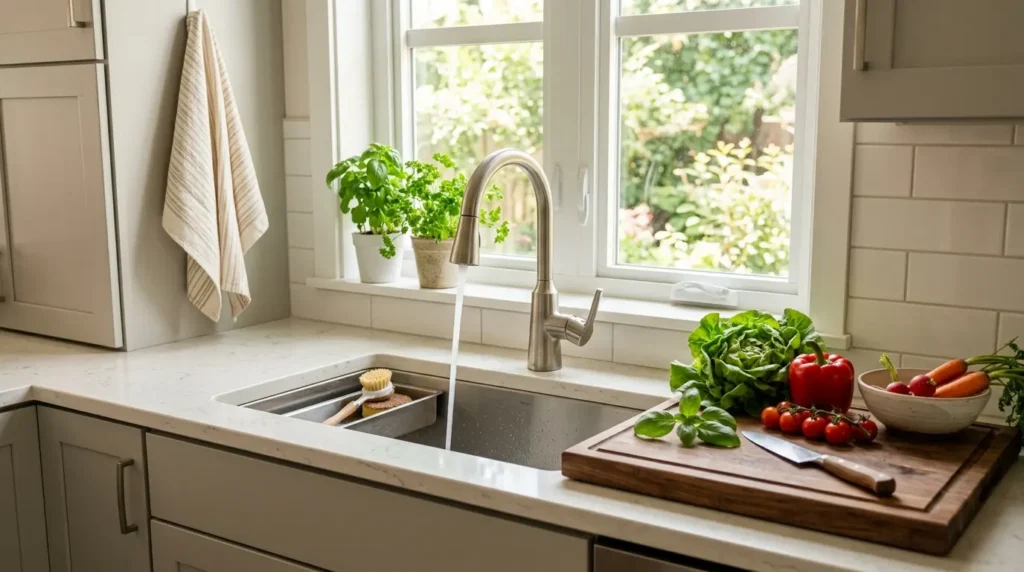
A single handle kitchen faucet controls hot water, cold water, and flow with one lever, which is why it’s become the default choice for most home kitchens. If you cook often, your hands are rarely free, and a faucet you can nudge on with a wrist or an elbow while you’re elbow-deep in bread dough or rinsing chicken saves real time at the sink. This guide walks through how these faucets work, what separates a good one from one that drips within a year, and how to match a model to your sink before you buy.
What Is a Single Handle Kitchen Faucet?
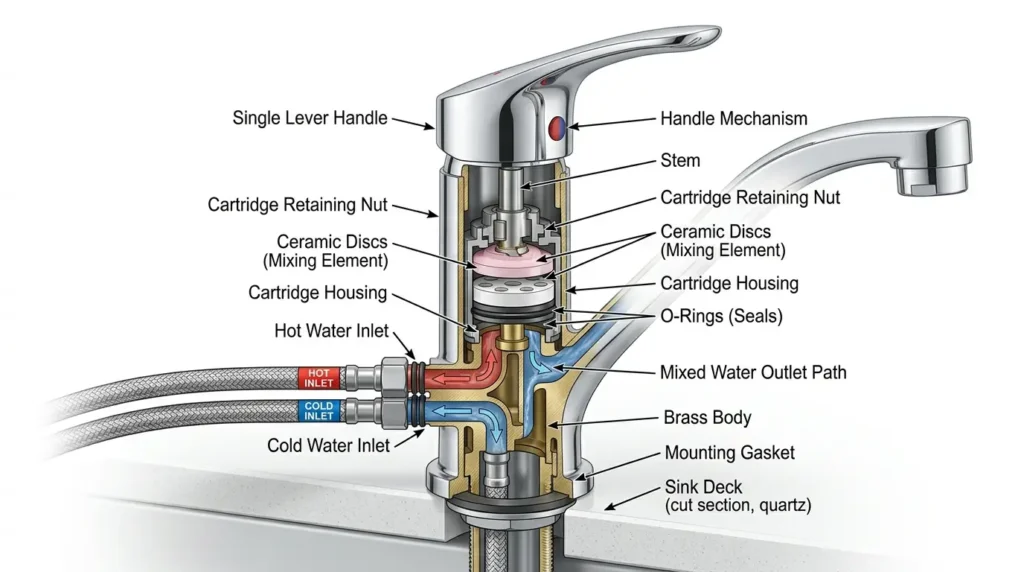
A single handle kitchen faucet uses one lever, connected to an internal cartridge, to control both water temperature and flow rate in a single motion. Push it up for more flow, slide it left or right to adjust temperature, and you’re done. Compare that to a two-handle faucet, where you’re turning one knob for hot and another for cold every single time you want warm water for washing greens or filling a stockpot.
Inside the faucet body, the cartridge does the real work. Most modern single handle faucets use a ceramic disc cartridge, which resists mineral buildup and wears far more slowly than the older rubber-and-spring or ball-valve designs found in older homes. When a single handle faucet finally does leak, it’s almost always this cartridge, not the whole unit, that needs replacing.
Single handle faucets also mount through one hole in the countertop or sink deck, which keeps the footprint small and the area around the base easy to wipe down after a cooking session. If your sink already has three holes from an older double-handle setup, you’re not out of luck. A deck plate (sometimes called an escutcheon) covers the extra holes so a single handle faucet still fits cleanly.
Single Handle vs. Two Handle: Which Fits Your Kitchen
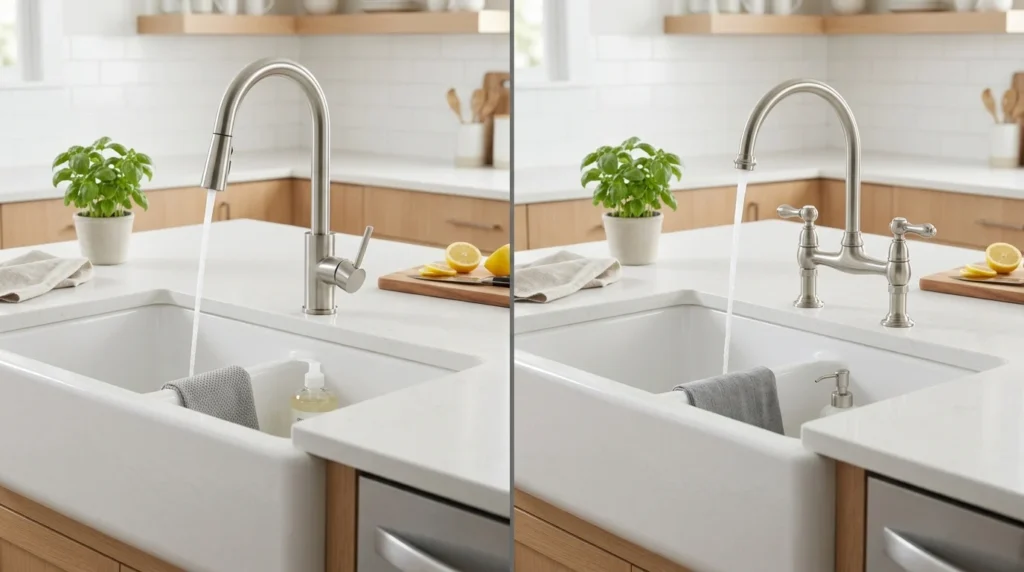
The honest answer is that neither style is universally better, but for how most people actually cook, single handle wins on convenience. It’s a one-motion adjustment, it’s easier to operate with a wrist or forearm when your hands are covered in flour, and it tends to be simpler and cheaper to install since it only needs one hole. Homeowners who deal with arthritis or limited grip strength often find single handle models noticeably easier to live with day to day.
Two-handle faucets have their own case. Some cooks like the finer, more deliberate temperature control that comes from adjusting hot and cold independently, and the classic look pairs well with traditional or farmhouse kitchen styles. The tradeoff is a bulkier footprint, a three-hole installation, and, because there are more moving parts, more places where a leak can eventually start.
If your kitchen sees a lot of daily traffic, whether that’s a family cooking three meals a day or a small household that just values speed at the sink, a single handle kitchen faucet is generally the more practical pick. If your priority is matching a period kitchen’s aesthetic or you want granular hot-and-cold control, a two-handle faucet is still a reasonable choice.
How to Choose the Right Single Handle Kitchen Faucet for Your Sink
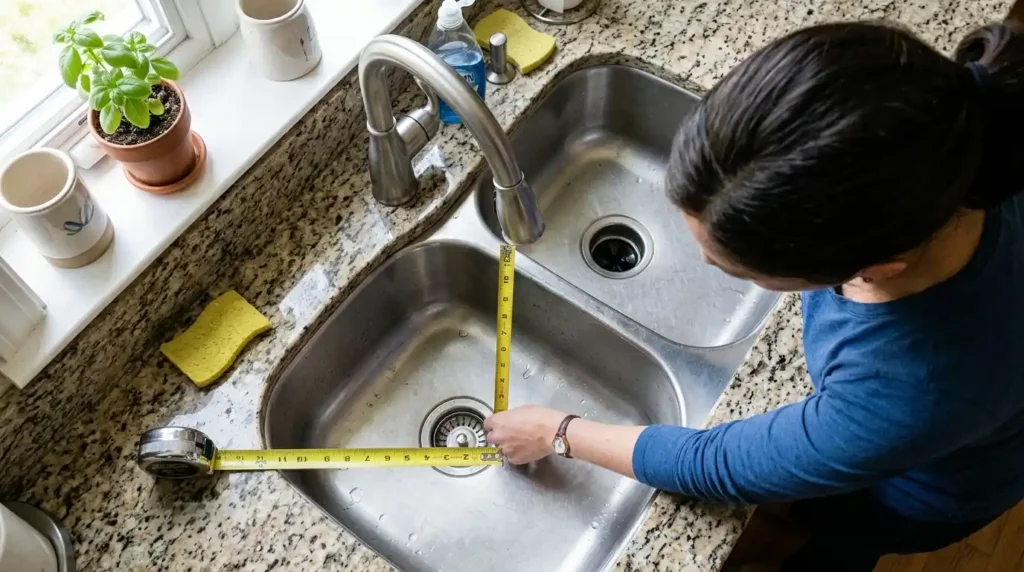
Picking a faucet starts with your sink, not the showroom. Two measurements matter more than any spec sheet: spout height and spout reach.
Spout height determines how much clearance you have for tall stockpots, pitchers, or a colander of vegetables under the running water. High-arc spouts, typically 14 to 22 inches, give the most room and work well over deep sinks. Low-arc spouts sit closer to the sink and fit under cabinets, windows, or open shelves without banging into anything.
Spout reach is the distance from the base of the faucet to where the water actually lands. You want that stream centered over your sink bowl, not splashing the back wall or missing the front edge. Most kitchen sinks are well served by a 7 to 9 inch reach, though a farmhouse sink or a double-bowl layout may need something longer.
From there, think about how you actually use your kitchen sink:
- Batch cooking or canning: a high-arc pull-down faucet with a strong flow rate makes filling large pots faster.
- Small or galley kitchen: a compact pull-out model with a shorter spout keeps the sink from feeling crowded.
- Frequent produce washing: look for a spray head with a dedicated rinse mode and a hose long enough to reach every corner of the sink.
- Shared or accessible kitchen: prioritize a lever with light, ADA-friendly handle travel that doesn’t require a tight grip.
One more fit question: how many holes does your sink have? A one-hole sink is ready for a single handle faucet as-is. A three-hole sink needs a deck plate to cover the extra holes, or you can use the remaining holes for a soap dispenser or a filtered water tap.
Spout Styles: Pull-Down, Pull-Out, High-Arc, and Low-Arc
Once the basic fit is settled, the spray head style shapes daily use more than almost any other feature.
Pull-down faucets have a high-arc spout, and the spray head detaches and pulls straight down into the sink. This design is well suited to deep sinks and to cooks who regularly wash oversized pots, sheet pans, or roasting trays, since the water lands right where you’re working.
Pull-out faucets sit lower and the spray head extends toward you rather than down. They’re a common pick for shallow sinks or kitchens with a window or low cabinet right above the sink, since the compact profile avoids clearance problems entirely.
Most models in either category offer at least stream, spray, and pause modes, with some adding a wider sweep or blade spray for faster plate cleanup. A hose length of 20 to 30 inches covers most sinks comfortably, and a spray head that docks with a firm magnet rather than relying on weight alone tends to hold up better over years of daily pulling and releasing.
Materials, Cartridges, and Finishes That Actually Last
The parts you can’t see matter as much as the ones you can. A ceramic disc cartridge is the single biggest factor in how long a faucet stays drip-free, and it’s worth checking the spec sheet or product listing for this detail before buying. Braided stainless steel supply lines and hoses hold up better to years of flexing than plain rubber or vinyl.
Finish is where style and durability meet. Chrome is bright and inexpensive but shows water spots quickly. Brushed nickel and stainless steel hide smudges and small scratches well, which matters in a kitchen that gets touched constantly. Matte black has become a popular choice for modern kitchens, though the quality of the coating varies a lot between budget and premium models. Physical vapor deposition, or PVD, finishes resist scratching and spotting noticeably better than basic electroplating, and many manufacturers back them with a lifetime finish warranty separate from the mechanical warranty on the cartridge and internal parts.
A quick way to gauge quality before buying: check whether the manufacturer publishes a parts diagram with part numbers for the cartridge, O-rings, and aerator. If replacement parts are easy to find years down the line, that’s a good sign the company builds for the long haul.
Installation: What to Know Before You Buy
Most single handle kitchen faucets are designed for straightforward DIY installation if your shutoff valves work properly and your sink is in good shape. A basin wrench, an adjustable wrench, a bucket, and a bit of patience under the cabinet are usually all you need. Many current models include pre-attached supply lines and a rubber gasket at the base, which skips the plumber’s putty step entirely, though it’s worth checking your specific faucet’s instructions since not all models handle sealing the same way.
For a three-hole sink, a deck plate installs first, then the faucet mounts through the center hole. The main things that cause problems during installation are cross-threading a connector by starting it at an angle, skipping a level check on the base before tightening, and letting the spray hose sit somewhere it can kink under the cabinet. None of these are hard to avoid if you take installation slowly and hand-tighten every connection before reaching for a wrench.
If your shutoff valves won’t close, your supply lines show corrosion, or there’s already water damage under the sink, that’s the point to call a plumber rather than push forward with a DIY swap.
Is a Single Handle Kitchen Faucet Worth It?
Yes, for the vast majority of home kitchens. A single handle kitchen faucet offers one-motion temperature and flow control, a smaller countertop footprint, and fewer parts to maintain than a two-handle setup, all of which add up to a faucet that’s genuinely easier to live with. The main tradeoff is slightly less precise hot-and-cold fine-tuning, which rarely outweighs the convenience for anyone who cooks regularly.
Is a single handle kitchen faucet better than a two handle faucet?
For most kitchens, yes. Single-handle faucets are easier to operate one-handed, install through a single hole, and have fewer moving parts that can eventually wear out. Two-handle faucets can offer more precise temperature control and suit a traditional kitchen aesthetic, but they’re bulkier and typically cost more to install. The right choice comes down to how often you cook and what look you’re going for.
What GPM should I look for in a kitchen faucet?
Federal rules cap kitchen faucets at 2.2 gallons per minute (GPM) at 60 psi, though some states limit it further to 1.8 GPM to conserve water. Check your local plumbing code before buying, since a faucet rated above your area’s limit may not pass inspection. A well-designed aerator keeps flow feeling strong even at the lower rate, so you won’t necessarily notice a performance difference.
Do single handle kitchen faucets leak more than two handle models?
Not inherently. Leaks come down to cartridge quality and installation, not the number of handles. A single handle faucet with a ceramic disc cartridge typically resists leaks longer than an older two-handle faucet with rubber seals, since there’s only one cartridge to wear out instead of two separate valve stems.
Can I install a single handle faucet on a three-hole sink?
Yes. A deck plate, also called an escutcheon, covers the two extra holes while the faucet mounts through the center. Many homeowners use the remaining space for a soap dispenser or a filtered water dispenser instead of leaving the plate blank.
How long does a single handle kitchen faucet last?
With normal use and basic upkeep, most single handle kitchen faucets last 10 to 15 years. Cleaning the aerator every few months, especially in hard water areas, and replacing a worn cartridge when needed can stretch that lifespan considerably further.
Ready to shop? Measure your sink’s hole count, spout clearance, and reach before you browse so you can filter out anything that won’t actually fit, and check the cartridge and finish warranty on any model you’re considering.


Pingback: Best Refrigerator With Nugget Ice Maker 2026 | Buyer's Guide