
A refrigerator with nugget ice maker built into the door is no longer a rumor. For years, anyone who wanted the soft, chewable ice you get at Sonic or Chick-fil-A had exactly one real option: buy a separate countertop machine and find room for it on the counter. That changed in early 2026, when Whirlpool announced the first refrigerator with a true in-door nugget ice maker, and it’s worth understanding exactly what’s available, what still falls short, and what you’re actually getting for the money before you spend it.
This guide breaks down every current option, from the new Whirlpool model to Samsung’s Ice Bites and GE’s Opal line, with real prices, capacities, and the tradeoffs nobody puts in the spec sheet.
Which Refrigerator Has a Built-In Nugget Ice Maker Right Now
Whirlpool is the only brand with a true in-door nugget ice maker built directly into a refrigerator. The model, announced at the Kitchen and Bath Industry Show in February 2026, is a 36-inch true counter-depth French door refrigerator available in 3-door and 4-door versions, and it dispenses nugget ice straight from the exterior door, alongside regular cubed ice, with no scooping required. Samsung’s Bespoke line makes something close, called Ice Bites, but it comes from a bin inside the freezer drawer rather than a through-the-door dispenser, and it’s a molded ice bit rather than true extruded nugget ice. GE doesn’t put nugget ice in a refrigerator at all. Its award-winning Opal line is a standalone countertop appliance.
What Nugget Ice Actually Is, and Why the Difference Matters
Nugget ice, sometimes called pellet ice or pebble ice, is made by scraping a thin layer of ice off a freezing cylinder and compressing the flakes into small, soft cylinders. The compression traps air inside the ice, so a nugget is roughly half air by volume. That’s why it’s soft enough to chew without cracking a tooth, and why it soaks up flavor from soda or juice instead of just diluting it.

Crushed ice is a completely different process. It starts as a standard hard cube, and a blade or hammer mechanism just breaks it into smaller pieces. The result still freezes at the same density as a cube, so it’s sharp, it melts fast, and it doesn’t chew the same way. If a refrigerator listing advertises “crushed ice” or “soft ice,” that’s not the same feature as nugget ice, no matter how the marketing copy phrases it. This distinction trips up a lot of shoppers, and it’s the single most common reason people end up disappointed after buying a fridge for its ice.
Whirlpool’s Industry-First Refrigerator With Nugget Ice Maker
Whirlpool unveiled its nugget ice refrigerator at KBIS 2026 in Benton Harbor, and it’s the first appliance brand to put a true in-door nugget ice dispenser on a refrigerator rather than tucking it into a freezer drawer. A few details matter here that most coverage of the launch skipped over.
The built-in nugget ice maker holds up to 2.4 pounds of ice and features anti-clumping technology, which Whirlpool built specifically to solve the problem that plagues drawer-based nugget systems: ice sitting unused for a few days and fusing into a solid block. The bin is also removable, so you can pull it out and scoop directly if you’re filling a pitcher or a cooler for a party.
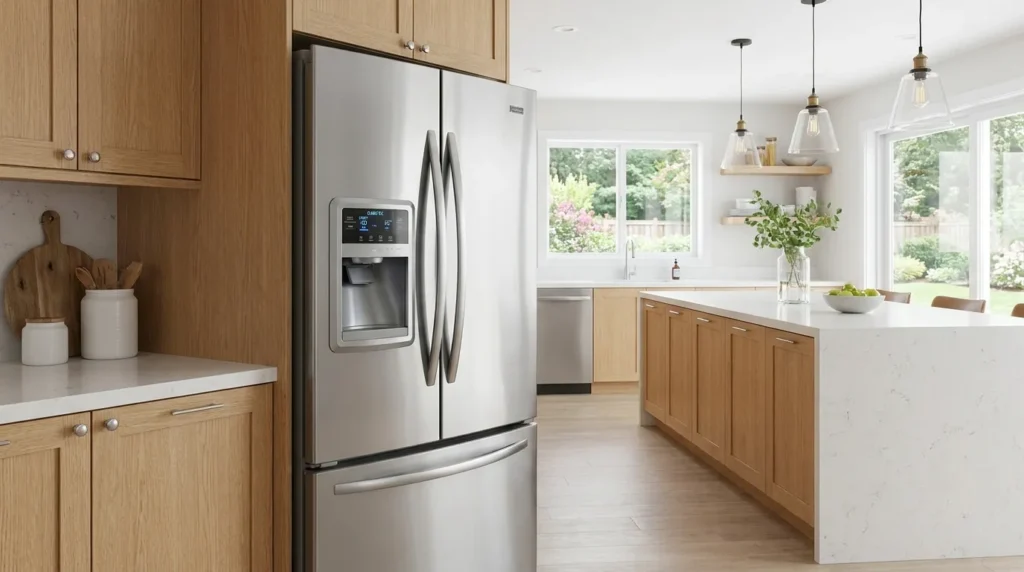
The refrigerator comes in a 36-inch wide true counter-depth build, offered as both a 3-door and 4-door French door configuration, and it dispenses both nugget ice and standard cubed ice from the same exterior door dispenser, so you’re not choosing one or the other when you buy it. Whirlpool has said the model is expected to reach retail later in 2026. If you’ve been holding off on a fridge purchase specifically to get this feature, that timeline is the one number worth tracking, since most retailers haven’t started taking pre-orders as of this writing.
Because this is a true integrated system rather than a repurposed countertop mechanism, it’s also the first design that could realistically make nugget ice a standard refrigerator feature over the next few years, the way in-door water dispensers became standard in the 2000s.
Samsung Bespoke Ice Bites: How Close Is It to Real Nugget Ice
Samsung has been in this space longer than anyone else, and its Bespoke and 4-Door Flex refrigerators use a Dual Auto Ice Maker in the freezer drawer, with one bin producing standard cubes and the other producing what Samsung brands as Ice Bites.
The honest answer, based on how the mechanism actually works, is that Ice Bites are close but not identical to nugget ice. Samsung’s system molds the ice into a small, squared-off shape rather than extruding it through a cylinder, so it chews more easily than a hard cube but doesn’t have the same porous, flaky texture as ice from a dedicated nugget maker. Owners commonly report that Ice Bites clump if the bin sits unused for a few days, which is the same issue Whirlpool’s anti-clumping tech was built to address.
Pricing runs from around $2,999 for a 23 cubic foot counter-depth Bespoke 4-Door Flex model up to $3,599 for the larger 29 cubic foot version with a Beverage Center. That price reflects the full refrigerator, not just the ice feature, and Samsung’s dual ice system is now standard across most of its higher-end Bespoke and French door lineup, not a rare upgrade.
GE Profile Opal: Why the Best Nugget Ice Still Isn’t Built Into a Fridge
GE owns the Opal brand, which is widely considered the gold standard for home nugget ice, and it’s worth being direct about this: GE has not integrated Opal’s extrusion technology into a refrigerator. Every Opal model, including the Opal 1.0, Opal 2.0, and Opal Ultra, is a standalone countertop unit.
What Opal offers instead is genuinely closer to commercial-quality nugget ice than anything built into a fridge today, because it uses true extrusion rather than molding. The Opal 2.0 produces up to 24 pounds of ice per day, and with the optional side tank it can run for roughly a day and a half without a refill. Pricing on GE’s own site currently ranges from about $249 for the original Opal 1.0 with side tank up to $694 for the Opal model bundled with a side tank and Bluetooth connectivity, with the Opal 2.0 and Opal Ultra landing in the $499 to $599 range.
If ice quality matters more to you than having everything behind one refrigerator door, a countertop Opal paired with any regular fridge will out-perform every in-fridge system currently on the market, full stop. The tradeoff is counter space and a second water line or manual fill routine, depending on the model you choose.
Refrigerator Nugget Ice Options Compared
| Brand & Model Type | Ice Format | Capacity / Output | Where It Comes From | Approximate Price |
|---|---|---|---|---|
| Whirlpool nugget ice refrigerator | True in-door nugget ice | Holds up to 2.4 lbs, anti-clumping bin | Exterior door dispenser | Not yet released; expected later in 2026 |
| Samsung Bespoke Ice Bites | Molded, nugget-style bits | Freezer drawer bin | Interior freezer drawer bin | $2,999 to $3,599 (full refrigerator) |
| GE Profile Opal 2.0 (countertop) | True extruded nugget ice | Up to 24 lbs per day | Standalone countertop unit | $499 to $599 |
| GE Profile Opal 1.0 (countertop) | True extruded nugget ice | Up to 24 lbs per day | Standalone countertop unit | $249 to $519 |
Installation and Space Requirements to Check First
Before you fall in love with any of these options, confirm your kitchen can actually support one. Every nugget ice system, whether it’s built into a refrigerator door or sitting on your counter, needs a dedicated water line.
For a built-in refrigerator system like Whirlpool’s or Samsung’s, that means a working shutoff valve and a quarter-inch stainless steel water line within about six feet of where the refrigerator will sit, on the same floor. This is the same requirement as any standard ice-and-water refrigerator, so if your current fridge already has an in-door dispenser, you likely already have the plumbing in place. Whirlpool’s new model is built as a true counter-depth unit, which means it sits flush with surrounding cabinets rather than protruding into the kitchen the way a standard-depth refrigerator does. That’s worth measuring for specifically if you’re replacing an older, deeper model, since counter-depth refrigerators typically hold less overall capacity for the same footprint.
For a countertop unit like the Opal, you have two paths. Some models connect directly to a water line the same way a refrigerator does, while others use a manual-fill side tank you top off by hand every day or two. The side tank version is more flexible if you don’t have a water hookup near your counter, but it does mean one more daily chore. Either way, factor in roughly 10 to 17 inches of counter width and depth, plus clearance above the unit for the lid to open fully.
Built-In vs. Standalone Nugget Ice Maker: Which Should You Buy
This is the decision most shoppers actually need help with, and it comes down to three questions.
How much do you care about ice quality specifically? If you want ice as close as possible to what you’d get at a drive-through, a dedicated extrusion machine like the Opal still wins. Nothing built into a refrigerator today extrudes ice the same way.
How much counter or storage space do you have? A built-in system, whether it’s Whirlpool’s new door dispenser or Samsung’s drawer bin, saves you the footprint of a separate appliance entirely. That matters more in smaller kitchens or for anyone who’s already tight on counter space.
Are you buying a new refrigerator anyway? If you’re already shopping for a full refrigerator replacement, the built-in nugget ice feature adds real convenience with no extra appliance to manage. If your current fridge works fine, buying a $499 to $599 countertop nugget ice maker is a much smaller investment than replacing an entire refrigerator to get the feature, and it produces better ice in the process.
Cost, Repairs, and Maintenance Nobody Mentions Upfront
An in-door or in-drawer ice maker is a mechanical system with moving parts, and it lives inside a refrigerator that has to maintain multiple temperature zones at once. That combination means repairs on integrated ice makers tend to run higher than repairs on a standalone countertop unit, and diagnosing the issue often takes longer because a technician has to access it through the refrigerator’s internal wiring and plumbing rather than popping open a self-contained countertop box.
Nugget ice mechanisms specifically are more prone to mineral scaling than standard cube makers, because the extrusion or molding process runs water through narrow channels more frequently. Regular filter changes and, in the case of countertop units, using filtered or softened water where possible will extend the life of either type of system considerably. If you’re on hard water and skip filter maintenance, expect more frequent service calls regardless of which brand you choose.
A standalone countertop maker also has one practical advantage worth weighing: if it breaks, you replace or repair a $500 appliance, not a $3,000 to $4,000 refrigerator, and you’re not without a fridge while it’s serviced.
What Should You Check Before Buying a Refrigerator With Nugget Ice?
Before you buy, check these details.
1. Confirm the ice type
Do not buy based on a product title alone. Make sure the manufacturer specifically describes the ice as nugget or chewable ice.
2. Check ice capacity
Find out how much nugget ice the refrigerator can hold. Whirlpool currently lists up to 2.4 pounds for its built-in nugget ice maker.
3. Check for a second ice maker
If you like both nugget ice and normal cubes, a dual-ice setup can be extremely useful. You can use nugget ice for drinks and regular cubes for coolers or other situations.
4. Measure your kitchen
This sounds obvious, but refrigerator replacements often go wrong here.
Measure:
- Width
- Height
- Depth
- Door clearance
- Hinge clearance
- Counter clearance
- Water-line location
Also remember that counter-depth does not mean the entire refrigerator will have exactly the same depth as your cabinets.
5. Check the water connection
Built-in ice makers typically require a water connection. Make sure your kitchen has the correct water line and that the installation location works for the refrigerator you choose.
6. Look at cleaning requirements
Any appliance that constantly handles water and ice needs cleaning. Check the manufacturer’s cleaning instructions before you buy. A complicated ice system may require more maintenance than a basic refrigerator.
7. Check warranty and service
A refrigerator is a major appliance. Look at the warranty terms and make sure authorized service is available in your area. Do not judge a refrigerator only by its ice. You are buying a refrigerator first and an ice maker second.
How to Choose the Right Option for Your Kitchen
Start with your water line. Any nugget ice system, built-in or countertop, needs a water connection, and a countertop unit needs either a hookup near your counter or a manual-fill tank you refill by hand. Check what’s realistic in your kitchen before comparing features.
Next, think about how you’ll actually use the ice. If it’s mostly for personal drinks throughout the day, a smaller-capacity system like a fridge-integrated dispenser is plenty. If you host regularly, entertain, or go through large amounts of ice for coolers and pitchers, a higher-output machine like the Opal 2.0’s 24 pounds per day will keep up better than a 2 to 3 pound bin that needs frequent refill cycles.
Finally, factor in timing. If you specifically want Whirlpool’s in-door nugget ice refrigerator, it hasn’t hit retail yet as of this writing, so you’re either waiting for release or choosing between Samsung’s Ice Bites now and a countertop unit you can buy today.
It also helps to think about what happens if the ice maker itself needs service years down the line. A refrigerator is a multi-thousand-dollar purchase you’ll likely keep for a decade or more, while a countertop nugget ice maker is a smaller, self-contained investment you can replace on its own schedule without touching the rest of your kitchen. Neither approach is wrong, but knowing which tradeoff you’re comfortable with before you buy will save you from a return trip to the appliance store six months later.
Who Should Buy a Refrigerator With Nugget Ice?
A built-in nugget ice refrigerator is a good choice if:
- You already need a new refrigerator
- You drink nugget ice every day
- You want to save counter space
- You want both nugget and regular ice
- You entertain often
- You want fewer appliances on your counter
Who Should Buy a Countertop Nugget Ice Maker?
A countertop machine makes more sense if:
- Your current refrigerator is still good
- You mainly care about the ice
- You have a limited appliance budget
- You do not want to replace your refrigerator
- You want the flexibility to replace the ice maker later
Is nugget ice the same as crushed ice?
No. Crushed ice is a standard hard cube broken into fragments, so it’s dense and melts quickly. Nugget ice is made from compressed ice flakes and is roughly half air, which is why it’s soft enough to chew and holds its texture longer in a drink.
Which refrigerator brand makes the best nugget ice?
As of 2026, no refrigerator brand extrudes true nugget ice the way GE’s standalone Opal does. Whirlpool’s new in-door system and Samsung’s Ice Bites are the closest built-in options, but for the highest-quality texture, a countertop Opal paired with any refrigerator still produces better ice.
Can I add a nugget ice maker to a refrigerator I already own?
Not realistically. The water delivery and freezing mechanism required for nugget ice is built into the refrigerator’s internal plumbing and can’t be retrofitted into a standard ice maker slot. A standalone countertop unit is the only practical option if you’re not replacing your fridge.
Why do nugget ice systems cost more or break down more often?
The extrusion or molding process runs water through narrow mechanical channels more frequently than a standard cube tray, which increases exposure to mineral buildup and scaling. That means more moving parts, more cleaning requirements, and typically higher repair costs than a basic ice maker.
When will the Whirlpool nugget ice refrigerator be available to buy?
Whirlpool announced the model at KBIS in February 2026 and has said it’s targeting a broader retail launch later in the year. Check with major appliance retailers directly for current availability in your area, since exact dates can shift before a full rollout.
Final Verdict
The search for a refrigerator with nugget ice maker has become much easier in 2026.
For years, shoppers had to choose between a regular refrigerator with ordinary ice and a separate countertop machine. Samsung’s Ice Bites system gave buyers another option, but it uses Samsung’s own small, chewable ice format.
Whirlpool has now moved the category forward with a refrigerator that puts nugget ice directly inside the appliance. Its system offers soft, chewable nugget ice, a removable 2.4-pound container, anti-clumping technology, and traditional ice options as well.
That makes it the most interesting choice for someone who is already ready to replace their refrigerator.
But you should not automatically buy a new refrigerator just for nugget ice.
If your current refrigerator is working well, a countertop machine may give you the better overall value. GE Profile’s Opal lineup remains a strong option, and the newer Opal Mini makes the countertop approach more practical for smaller kitchens.
The right choice comes down to one simple question:
Are you buying a refrigerator because you need a new refrigerator, or are you buying it because you want nugget ice?
If you need both, a built-in nugget ice refrigerator makes a lot of sense.
If you only want the ice, keep your existing refrigerator and buy a dedicated nugget ice maker instead.