
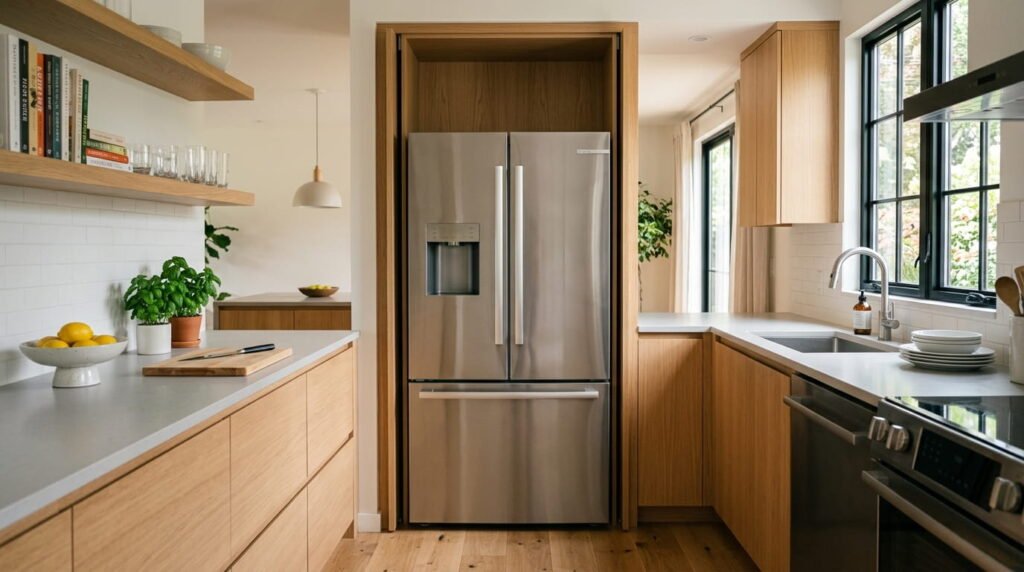
A 32 inch wide refrigerator sits in an awkward but useful gap between compact apartment units and the standard 36-inch fridge most kitchens are built around. If your cabinet opening won’t take a full-size French door model, or you’re outfitting a galley kitchen, condo, or secondary prep space, this width often hits the sweet spot between capacity and fit. Here’s what to know before you measure, shop, or swap out an old unit.
In a 32-Inch Fridge Fit My Kitchen?
A true 32-inch wide refrigerator needs a cabinet opening of at least 32.5 to 33 inches once you account for standard side clearance. Most kitchens built for a “32-inch” cutout can actually accommodate anywhere from 30 to 33 inches, so measure your opening at the top, middle, and bottom before assuming a specific model will fit. The narrowest of those three numbers is the one that matters.
What Counts as a 32 Inch Wide Refrigerator?
Refrigerator widths are marketed in round numbers, but actual dimensions vary by a few inches from model to model. A refrigerator labeled around 32 inches wide might measure anywhere from 30 to 33 inches without handles, and handles can add another inch or two on each side. That gap between marketing width and real width is the single biggest reason people end up with a fridge that doesn’t quite slide into place. Always check the spec sheet for exact width, not just the category label a retailer uses.
This width falls between compact mini fridges and the 36-inch models that dominate big-box store aisles. It works well in galley kitchens, smaller apartments, condos, and secondary prep areas, since it fits narrower cabinet openings without crowding walkways. It’s also a common replacement size for older homes, where existing cutouts were never built to modern 36-inch standards.
Standard-Depth vs. Counter-Depth in This Width
Depth matters just as much as width. Standard-depth refrigerators typically run 30 to 36 inches deep and stick out several inches past a 24- to 25-inch countertop. Counter-depth models are shallower, usually 24 to 30 inches deep, and sit closer to flush with your cabinetry for a more built-in look.
The tradeoff is capacity. Shaving off five or six inches of depth typically costs 4 to 6 cubic feet of interior storage compared to a standard-depth unit of the same width, since manufacturers have to redesign compressor placement and insulation to fit the shallower footprint. If you have a smaller household or one to three people, that reduced capacity is usually manageable. Larger families filling a fridge weekly may notice the difference and end up shopping more often.
Several 32-inch bottom-freezer and French door models are available in counter-depth configurations specifically because manufacturers widen a shallower unit to make up for the lost depth. If a flush, built-in look matters to you, this width is one of the more common places to find that option without stepping up to true built-in pricing.
How to Measure for a 32 Inch Wide Refrigerator
Getting the width right isn’t the whole job. Before shopping:
- Measure the opening’s width at the top, middle, and bottom of the space, and use the smallest number as your safe width.
- Measure height from the floor to the bottom of any overhead cabinet, checking front and back since floors and cabinets settle unevenly over time.
- Measure depth from the wall to the front edge of your countertop, not to the front of your current fridge door.
- Leave clearance. Plan for roughly half an inch of side clearance for ventilation, and if one side sits against a wall, leave two to four inches so the hinge-side door can swing open fully.
- Check the delivery path. Measure hallways, doorways, and any tight turns between your entrance and the kitchen so the new unit can actually get inside.
Skipping the depth and clearance measurements is the most common mistake. A refrigerator can fit the width of an opening and still be unusable if the doors can’t open to 90 degrees for drawer access, or if it won’t clear the front hallway on delivery day.
Configurations Available at 32 Inches Wide
Top-freezer: The most budget-friendly layout at this width, with a simple design and usually the most interior capacity per dollar. Doors typically need a wide swing to fully open.
Bottom-freezer: Puts fresh food at eye level, which many households find more convenient day to day. Freezer drawers tend to slide out more easily than a top-freezer’s shelf.
French door: Popular for kitchens near an island, since the narrower double doors need less clearance to swing fully open. Several counter-depth options exist in this width specifically for this reason.
Side-by-side: Less common at 32 inches, since the narrower cabinets it splits between two tall, narrow compartments, but it remains a fit for households that prioritize water and ice dispenser access over shelf width.
Capacity: What to Expect
For a 32-inch wide model, expect somewhere between 14 and 22 cubic feet of total capacity, depending on configuration and depth. As a rough planning guide, aim for 4 to 6 cubic feet per person in the household, meaning a couple typically needs 8 to 12 cubic feet minimum and a family of four should look for 16 or more. Counter-depth versions in this width will land toward the lower end of that range because of the shallower cabinet.
Common Questions About 32 Inch Wide Refrigerators
Is a 32 inch wide refrigerator too small for a family?
Not necessarily. Many 32-inch French door and bottom-freezer models offer 18 to 22 cubic feet, which comfortably covers a family of four when combined with regular grocery trips. Families that stock up in bulk or host often may prefer stepping up to a 33- or 36-inch model if the cabinet opening allows it.
What’s the difference between a 32-inch and 33-inch refrigerator?
The one-inch difference rarely changes capacity dramatically on its own, but it does affect which models are available to you. Many manufacturers market their narrow lineup specifically at 33 inches, so a kitchen that can handle either width will generally have more choices at 33 inches than at a true 32.
Can I fit a 32 inch refrigerator into a 36 inch opening?
Yes, and it’s a common approach in kitchens with a wider-than-needed cutout. You’ll have extra clearance on one or both sides, which can be filled with a matching panel, filler strip, or simply left as breathing room. Just confirm the narrower unit still meets the depth of your existing cabinetry so it doesn’t look recessed or oddly placed.
Do 32 inch refrigerators come with an ice maker?
Many do, particularly French door and bottom-freezer configurations from major brands. Basic top-freezer models at the lower end of the price range are more likely to skip the ice maker, so check the spec sheet if it’s a must-have feature.
Bottom Line
A 32 inch wide refrigerator is a practical middle ground for kitchens that can’t take a full 36-inch model but need more than a compact unit provides. Measure your actual opening at three points, decide whether counter-depth or standard-depth suits your kitchen’s layout, and match the configuration to how your household actually uses a fridge day to day. Getting those details right before you shop is what prevents a delivery-day surprise.


Pingback: Best Refrigerator With Nugget Ice Maker 2026 | Buyer's Guide