
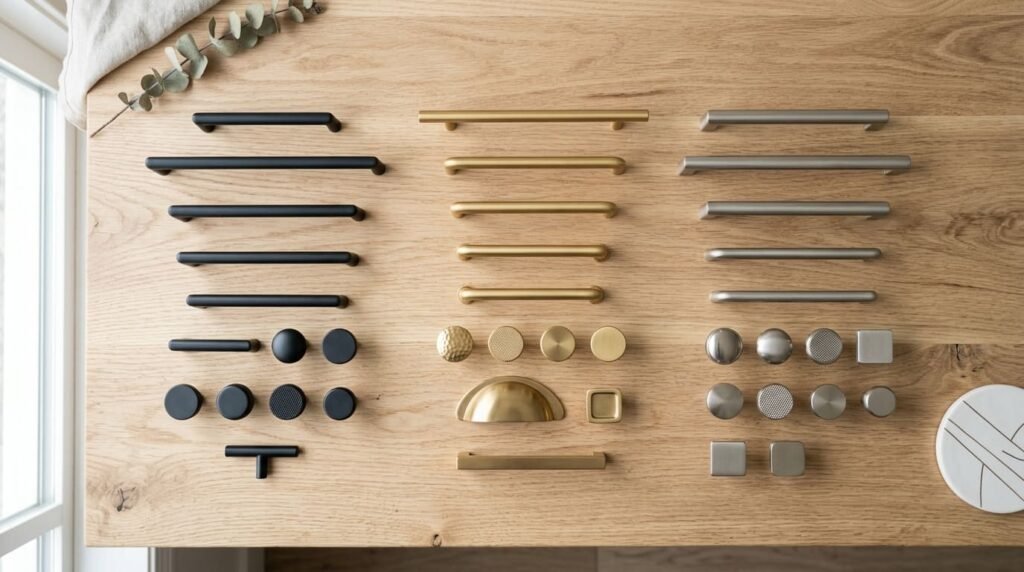
Kitchen handles are one of the smallest purchases in a renovation and one of the easiest to get wrong. Get the size, spacing, or finish off by even a little, and it shows every single time you open a drawer. This guide walks through the real decisions: knobs versus pulls, what size to buy, how center-to-center spacing works, and which finishes hold up to daily kitchen use.
Kitchen Handles vs. Knobs: Which Should You Choose?
Most kitchens end up using both, just in different places. Knobs are single-hole hardware, gripped with the fingertips, and they tend to read as more classic or traditional. Handles, also called pulls, mount with two screws and give a full-hand grip, which makes them the more practical choice for anything that gets pulled hard or often.
A common approach: knobs on upper cabinet doors, where a light touch is all that’s needed, and pulls on lower cabinets and drawers, where you’re often opening them with a full hand, sometimes wet or greasy from cooking. Heavier drawers, like a trash pull-out or a deep pot drawer, do better with a longer pull because it distributes the pulling force across two mounting points instead of one. Knobs are also usually the cheaper option per piece, so budget can factor into the split as well.
There’s no rule that says a kitchen has to pick one and use it everywhere. Mixing knobs on doors and pulls on drawers is one of the most common combinations in both modern and traditional kitchens.
Types of Kitchen Handles to Know
Before shopping, it helps to know the basic shapes you’ll run into:
- Bar pulls: straight, cylindrical handles mounted horizontally or vertically. The most common style in modern and transitional kitchens.
- Cup pulls: half-moon or hooded pulls that hook under the fingers rather than around them. A good option for painted drawer fronts, since there’s less finish wear from repeated gripping.
- Edge pulls: mount along the top or side edge of a door or drawer, sitting nearly flush with the surface. These give a handle-free, streamlined look that’s popular in sleek, minimalist kitchens.
- Appliance pulls: extra-long bar pulls sized for panel-ready refrigerators, freezers, and dishwashers.
Knowing the category makes it much easier to search and filter once you’re browsing a retailer’s site, since “bar pull” and “cup pull” behave very differently in terms of size and installation.
How to Choose the Right Size Kitchen Handles
Size is where most kitchen handle purchases go wrong, usually because people buy based on how a photo looks online rather than measuring their own cabinets first.
A widely used rule of thumb is that a pull should run roughly one-third the width of the drawer or one-third the height of the cabinet door it’s mounted on. In practical terms, that tends to break down like this:
- Small drawers (under 12 inches wide): a knob or a short 3-inch pull
- Standard drawers (12 to 24 inches wide): pulls in the 4- to 5-inch range
- Wide or oversized drawers (over 30 inches): a single 6- to 8-inch pull, or two smaller pulls mounted side by side
- Upper cabinet doors: handles in the 3- to 5-inch range are usually enough; anything longer can look oversized that high up
Projection, meaning how far the handle sticks out from the surface, matters too. A pull with very little projection can be hard to grip with wet hands, while one that sticks out too far tends to catch on sleeves and pockets as people move through the kitchen.
Center-to-Center Spacing Explained
Quick answer: Center-to-center (often shortened to CC or C-C) is the distance between the middle of one screw hole and the middle of the other on a two-hole pull. It’s the single most important number when buying kitchen handles, because it has to match your existing drilled holes or the spacing you plan to drill.
Common center-to-center sizes are 3 inches (76mm), 3.75 inches (96mm), 5 inches (128mm), and 6.25 inches (160mm). If you’re replacing old kitchen handles, measure your current hardware’s CC spacing before you shop, ideally in millimeters, since most hardware is manufactured to metric spacing and a 5-inch pull is not quite the same as a 128mm one. If the CC doesn’t match and you don’t want to drill new holes, a backplate can cover the old holes while letting you mount a different handle style on top.
For knobs, there’s no center-to-center measurement to worry about since there’s only one hole. The main placement decision there is how far in from the edge of the door the knob sits, which is typically around 2.5 to 3 inches.
Materials and Finishes That Fit Your Kitchen Style
Kitchen handles take a beating: grease, water, hand cream, and constant touching. Finish choice affects both the look and how well the hardware holds up.
- Matte black: a classic pairing with white or light cabinetry, and it tends to hide fingerprints better than shiny finishes.
- Brushed nickel and stainless steel: neutral, low-maintenance, and easy to match with most kitchen fixtures.
- Brass and gold: brass has a warmer, slightly antiqued look, while gold finishes read as brighter and more polished. They’re close in color family but noticeably different once installed side by side.
- Bronze: a warmer, darker option that suits rustic or farmhouse-style kitchens.
- Wood: less common but a good fit for natural or Scandinavian-style kitchens, since it brings warmth that metal finishes don’t.
A practical guideline that designers repeat often: stick to two or three finishes maximum across the whole kitchen, including faucets, lighting, and appliances. More than that and the space starts to feel visually busy rather than intentional.
Where to Place Kitchen Handles on Cabinets and Drawers
Placement is a smaller decision than sizing but still affects how the kitchen reads as a whole. For upper cabinet doors, handles or knobs are typically installed near the bottom corner, opposite the hinge, so they’re within easy reach. For lower cabinet doors, the same logic runs in reverse: hardware sits near the top corner, opposite the hinge, so you’re not bending down to open it.
On drawers, a single pull is usually centered horizontally across the drawer front. For very wide drawers, two pulls spaced evenly apart give a more balanced look and split the pulling force, which matters for anything heavy.
Consistency matters more than any individual rule. Once a height or placement is chosen for a row of cabinets, keeping it identical across every door in that run is what makes a kitchen look finished rather than patched together.
Mixing Knobs and Handles: Is It Okay?
Yes, and in most real kitchens it’s the norm rather than the exception. The most common combination is knobs on cabinet doors and pulls on drawers, which plays to each style’s strengths: knobs are compact and suit a lighter touch, while pulls give the leverage a heavier drawer needs.
Mixing finishes is a separate question from mixing shapes, and it’s worth being more careful there. A kitchen can successfully combine brass pulls with black knobs, for example, but pairing three or more finishes across the same run of cabinets usually starts to look accidental rather than designed.
Frequently Asked Questions
Are handles or knobs better for kitchen cabinets?
Neither is universally better. Pulls give a stronger grip and are easier to use for anyone with limited hand strength, including older adults and people with arthritis, which makes them a common choice for drawers and heavy doors. Knobs cost less, install faster, and suit lighter-use upper cabinets. Many kitchens use both.
What size handles do I need for kitchen cabinets?
As a starting point, aim for a pull length around one-third the width of the drawer or height of the door. Small drawers generally take 3-inch pulls, standard drawers take 4- to 5-inch pulls, and oversized drawers take 6-inch-plus pulls or two smaller pulls mounted side by side.
How do I measure center-to-center spacing on kitchen handles?
Measure from the middle of one screw hole to the middle of the other, not from the outer edges of the hardware. Use millimeters if possible, since most manufacturers size hardware to metric spacing, and double-check against your existing pre-drilled holes before ordering replacements.
Can I install kitchen handles myself?
Yes, for most cabinet doors and drawers it’s a straightforward DIY job with a drill, a template or measuring tape, and the correct screws. The main things to get right are the center-to-center spacing and keeping the placement consistent across every door and drawer in the same row.
Do kitchen handles need to match the faucet finish?
Not exactly, but they should coordinate with it. Matching every metal finish in the kitchen exactly can look flat. A common approach is to keep hardware and faucet in the same finish family, such as pairing brushed nickel handles with a brushed nickel or chrome faucet, rather than requiring an identical match.


Pingback: Pre Finished Hardwood Flooring: Cost, Pros & Picks (2026)