Barn Door Hardware Kit: How to Choose the Right One
Buying a barn door hardware kit looks simple until you start comparing track lengths, weight ratings, mounting systems, rollers, spacers, and door sizes.
The most common mistake is choosing a kit because it looks good or because it fits the door width. A barn door is supported by the hardware above the opening, so the track, mounting surface, and rollers all have to work together. A beautiful black steel kit will not solve the problem if the track is too short or the wall cannot support the load.
The good news is that choosing the right hardware does not require complicated calculations. Start with the door’s width, height, thickness, weight, and available wall space. Then check how the track will be attached to the structure behind the wall.
For example, imagine you have a 36-inch-wide solid wood door for a bedroom. A single-door sliding system may be a straightforward choice, but you still need enough track for the door to move completely past the opening. If the wall has a window immediately beside the doorway, the usual setup may not work at all.
That is why the best barn door hardware kit is not necessarily the most expensive one. It is the one that matches the door, opening, wall structure, available clearance, and way you intend to use the door.
What Is Included in a Barn Door Hardware Kit?
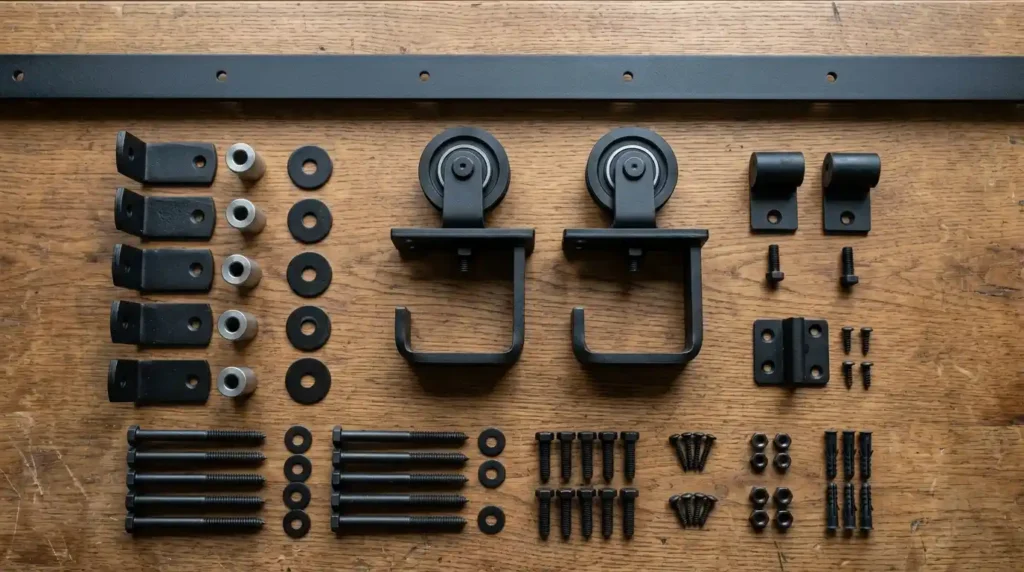
A typical kit is the operating hardware for a sliding barn door. The door panel itself is usually sold separately.
Depending on the kit, you may receive:
- A steel or aluminum track
- Roller hangers
- Mounting brackets or spacers
- Track end stops
- Anti-jump or door-retention hardware
- Floor guide
- Bolts, nuts, and washers
- Mounting hardware for the intended surface
Some packages also include handles, soft-close mechanisms, or a header board, but you should never assume these parts are included.
This matters when comparing prices. One inexpensive-looking kit may contain only the basic track and rollers, while another package may include a floor guide, handles, spacers, and upgraded mounting hardware.
Before buying, open the manufacturer’s parts list and check exactly what is in the box.
What You Usually Have to Buy Separately
The door slab is the obvious item, but there can be other extras.
You may need a:
- Header board
- Door handle or pull
- Privacy latch
- Soft-close accessory
- Longer track
- Different mounting bolts
- Wall anchors appropriate for masonry
- Trim or spacers
A particularly common surprise is discovering that the included floor guide does not work with the bottom profile of the chosen door. Checking compatibility before installation is much easier than removing a freshly mounted track.
Which Type of Barn Door Hardware Should You Buy?
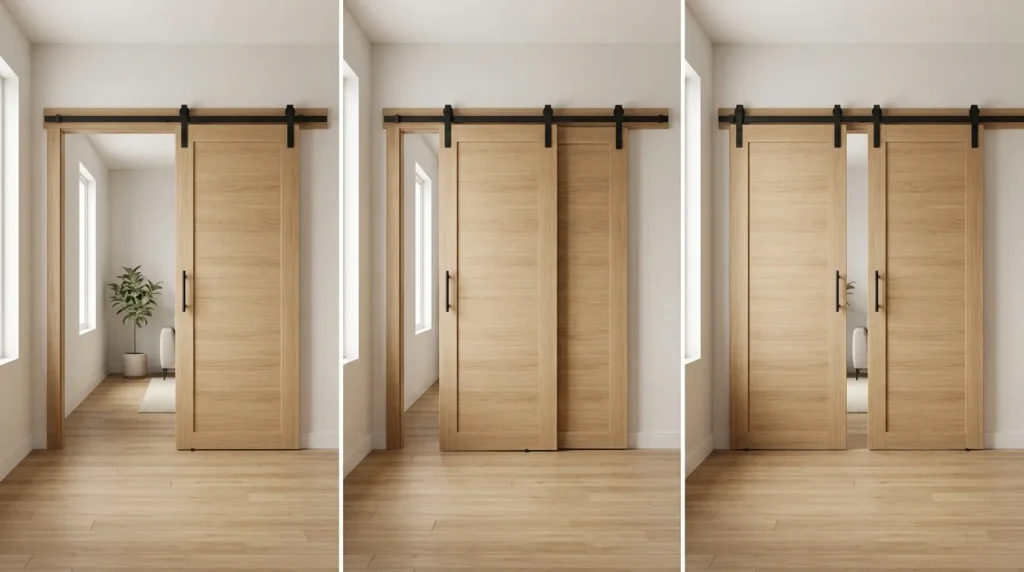
The right configuration depends largely on how the door needs to move.
Single-Door Hardware
This is the standard choice for one sliding door.
One door hangs from two rollers, which travel along a single horizontal track above the opening. It works well for bedrooms, offices, bathrooms, pantries, closets, and other interior spaces where there is enough clear wall beside the doorway.
Its biggest advantage is simplicity. There are fewer moving parts and fewer alignment issues than with more complicated systems.
The limitation is wall clearance. The door needs somewhere to go when it opens.
Bypass Barn Door Hardware
A bypass system uses two tracks so one door can slide behind another.
This is useful for wide closets and openings where there is not enough uninterrupted wall space beside the opening for two doors to sit next to each other.
Bypass systems can be especially useful for closets because the doors can overlap instead of requiring a large clear wall area.
The trade-off is that the doors occupy different planes. You also need to make sure the track spacing and door thickness are compatible.
Double Barn Door Hardware
A double-door setup allows two doors to meet in the middle and slide away from the opening in opposite directions.
It can be a good fit for a wide doorway with usable wall space on both sides.
Before ordering, measure both sides of the opening. A double barn door system only works well when each door has enough room to travel.
Bifold Barn Door Systems
Bifold barn door hardware is useful when side-to-side clearance is limited.
Instead of moving one large door completely along the wall, the panels fold as they move.
This can solve a clearance problem that a conventional single-track system cannot.
However, bifold hardware has more moving components and may require more careful installation and adjustment.
How Long Should a Barn Door Track Be?
Track length is one of the easiest things to get wrong.
For a typical single sliding door, a useful starting point is:
Track length ≈ 2 × door width
Then check the manufacturer’s required clearances and add length if necessary.
For example, if your door is 36 inches wide:
36 × 2 = 72 inches
A 72-inch track may be the starting point, but that does not automatically mean it will be correct for your installation. You need enough travel for the door to clear the opening while also accounting for the position of the track relative to the doorway.
This is where measuring the actual installation space matters more than blindly following a formula.
Check the Open Position
Stand beside the doorway and imagine the door sliding fully open.
Is there a wall, cabinet, window, light switch, outlet, or piece of trim in the way?
If the door cannot move far enough to the side, a longer track will not fix the problem. You may need a different door configuration or a different mounting arrangement.
For a 36-inch door, for instance, having 72 inches of theoretical track does not help if a wall obstruction stops the door after 55 inches of travel.
Measure the Finished Opening
Measure the doorway after the trim is installed.
Also measure:
- Door width
- Door height
- Door thickness
- Opening width
- Wall space beside the opening
- Available space above the opening
Do not rely solely on rough framing dimensions.
How Much Weight Can Barn Door Hardware Support?
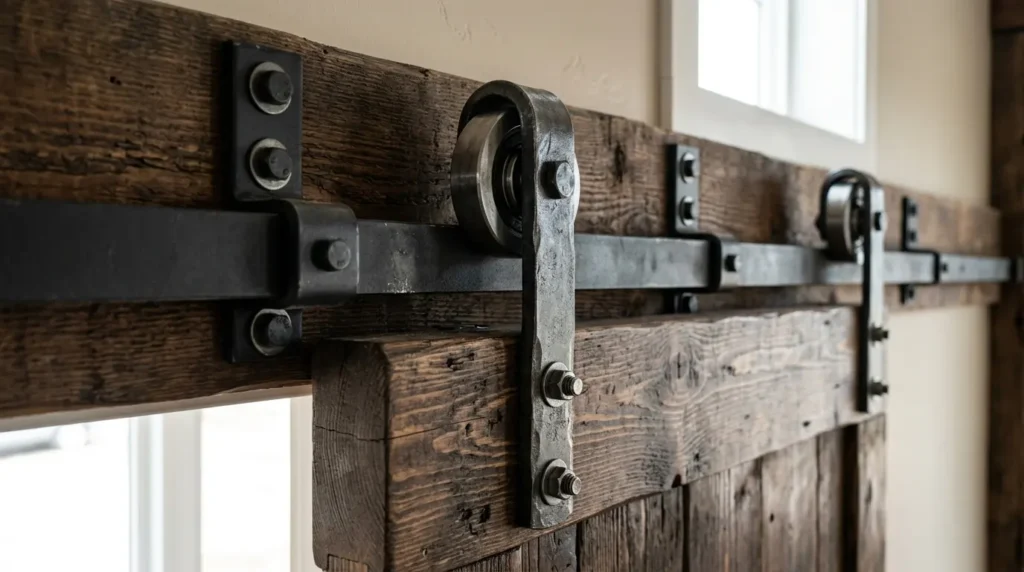
The door’s actual weight should be one of the first specifications you check.
A solid wood door can be substantially heavier than a hollow-core interior door of the same size. Glass, metal, thick hardwood, and oversized doors can also change the load dramatically.
Look for the manufacturer’s stated maximum door weight.
Do not choose a kit simply because your door happens to fall exactly under the published limit. A little capacity headroom is a sensible choice, particularly for a frequently used door.
For example, if your door is close to a kit’s maximum rated capacity, moving up to a higher-capacity system may give you a more appropriate margin.
The weight rating is not the only consideration, though. The wall and mounting structure must also be capable of carrying the load.
A high-capacity track attached incorrectly is still an unsafe installation.
Does Door Thickness Matter?
Yes.
The thickness of the door affects how far the door sits away from the wall and how the rollers, spacers, trim, and floor guide interact.
Many barn door kits are designed around common interior door thicknesses, but doors vary considerably.
Measure the actual door rather than assuming it matches a standard dimension.
This becomes particularly important when the doorway has thick casing or decorative trim. You may need additional standoff distance so the door can pass over the trim without rubbing.
Do You Need a Header Board?
Sometimes yes, sometimes no.
A header board is a solid piece of lumber installed above the doorway to provide a secure mounting surface for the barn door track.
It is particularly useful when the mounting holes in the track do not line up conveniently with wall studs.
Instead of trying to support the track with drywall anchors alone, the header can be securely attached to the underlying wall structure and provide a continuous mounting surface.
Why Drywall Alone Is a Problem
A barn door puts a significant load on the mounting points, especially when the door is moving.
Drywall is not structural framing.
If the kit’s mounting system is designed to attach to studs, joists, or another structural support, follow those requirements. Do not substitute ordinary drywall anchors simply because they are easier to install.
A common installation lesson is that the wall often matters more than the hardware. A premium track cannot compensate for weak mounting.
How Do You Know If Your Wall Can Support the Hardware?
Identify the structure behind the finished wall before drilling.
For a typical framed interior wall, this means locating the studs and determining whether the kit’s mounting points can be secured into them.
If the spacing does not work, a properly installed header board may provide a better solution.
For masonry walls, the mounting method is different. Concrete, brick, and block require fasteners appropriate for the specific substrate.
For ceilings, the track needs suitable structural attachment points rather than simply fastening into ceiling finish material.
If you are unsure what is behind the wall, stop before drilling. A few extra minutes spent locating the structure can prevent a much bigger repair later.
What Track and Roller Material Should You Choose?
Most interior barn door hardware uses steel components because they need to handle repeated movement and door weight.
The finish is largely a matter of appearance and environment, but construction quality affects how the system feels in use.
A good track should be straight and properly finished. Rollers should move smoothly without excessive play.
For a frequently used door, smoother rollers and better-finished components can be worth paying for because you interact with them every time the door opens.
Flat Track vs. Box Track
Flat track is the familiar exposed barn-door style. It makes the hardware part of the room’s visual design.
Box track encloses more of the rolling mechanism and can give the installation a cleaner appearance.
Neither automatically makes a better door. Choose based on the door’s weight, manufacturer’s specifications, installation requirements, and the look you want.
What About Noise?
Barn doors are not automatically silent.
The amount of noise depends on the rollers, track quality, installation, door movement, and how the door is stopped.
A door that is slightly misaligned can produce rattling or uneven movement even when the hardware itself is decent.
Soft-close hardware can reduce the impact when the door reaches the end of its travel. It is particularly useful in bedrooms, offices, and other spaces where a heavy door repeatedly hitting the stop becomes annoying.
If quiet operation matters, look beyond the product photograph and check how the roller system is constructed.
Barn Door Hardware Installation: The Details That Matter
Installing a basic system is within the reach of many experienced DIYers, but the work needs to be precise.
A typical installation involves:
- Measuring the opening and door.
- Confirming the door and hardware weight ratings.
- Locating studs or other structural mounting points.
- Installing a header if required.
- Positioning the track at the manufacturer’s specified height.
- Securing the track and checking that it is level.
- Installing the rollers on the door.
- Hanging the door.
- Installing the floor guide.
- Setting the track stops and anti-jump hardware.
- Testing the complete travel of the door.
Do not skip the level check.
A track that is slightly out of level can cause the door to move toward one side on its own. It can also create uneven contact and make the door feel worse than it should.
The floor guide deserves attention too. Its job is to control the bottom of the door while the upper rollers carry the load.
Five Barn Door Hardware Mistakes That Cause Problems
1. Buying the Track Before Measuring
The door width is not enough.
You also need to know how much wall space is available when the door is open.
2. Mounting Into Drywall Alone
This is one of the most serious shortcuts.
Follow the kit’s structural mounting requirements and use suitable fasteners for the wall construction.
3. Ignoring Door Thickness
A door can technically fit the track but still interfere with trim or sit incorrectly against the wall.
Measure the complete door assembly.
4. Forgetting the Floor Guide
Without proper bottom guidance, a sliding door can swing, shift, or move away from the wall.
5. Choosing Appearance Over Compatibility
Matte black hardware may look perfect in a product photo, but compatibility comes first.
Check weight rating, door thickness, track length, mounting method, and clearances before worrying about finish.
How Much Should You Spend on a Barn Door Hardware Kit?
Prices vary widely depending on track length, construction, finish, weight capacity, and included accessories.
Instead of setting a budget first, decide what the installation actually requires.
A basic interior single-door project may need only a straightforward track and roller system. A heavy solid-wood door, wide opening, bypass configuration, or soft-close setup will naturally require more specialized hardware.
When comparing two kits, compare what is actually included.
A cheaper kit may become more expensive after adding:
- A longer track
- Header board
- Floor guide
- Handles
- Soft-close hardware
- Different mounting hardware
The lowest sticker price is therefore not always the lowest project cost.
A Practical Buying Checklist
Before placing the order, confirm these details:
| What to Check | What You Need to Know |
|---|---|
| Door width | Exact finished width |
| Door height | Exact finished height |
| Door thickness | Actual thickness of the door |
| Door weight | Actual or reliable manufacturer specification |
| Track length | Enough travel for the opening and wall space |
| Mounting surface | Studs, header, masonry, or other structure |
| Door configuration | Single, double, bypass, or bifold |
| Floor guide | Compatible with the bottom of the door |
| Track clearance | Enough room above and around the doorway |
| Included parts | Track, rollers, stops, guides, fasteners, etc. |
| Finish | Compatible with the room |
| Accessories | Handle, latch, soft close if required |
Take these measurements before shopping rather than trying to make the hardware fit afterward.
When a Barn Door Is the Wrong Choice
Barn doors are attractive and useful, but they are not ideal for every opening.
A sliding door needs wall space beside the opening. It also does not provide the same seal or privacy characteristics as a conventional hinged door.
For a bathroom or bedroom, think about how much privacy and sound control you actually need.
A barn door can also leave gaps around the edges, depending on its design and installation. If the room needs a tight seal, a conventional hinged door may be more appropriate.
This is one of those cases where changing the hardware will not solve a problem caused by the basic door design.
Final Thoughts: Choose the Hardware Around the Door
The safest way to shop for a barn door hardware kit is to work backward from the installation.
Measure the door. Weigh it. Measure the opening. Check the wall space. Find the structural mounting points. Then choose the track system.
A single 36-inch interior door with plenty of wall space may need a simple single-track kit. A wide closet with limited side clearance may call for bypass hardware. A heavy custom door may need a higher-capacity system and stronger mounting arrangement.
The hardware should fit the project—not the other way around.
Does a barn door hardware kit include the door?
Usually, no. Most hardware kits include the track, rollers, stops, mounting components, and floor guide, while the door panel is purchased separately. Some retailers sell complete door-and-hardware packages, so check the product contents before ordering.
What size barn door hardware do I need?
Start with the door’s width, weight, thickness, and the amount of wall space available beside the opening. For a conventional single-door system, track length is often based around twice the door width, but the manufacturer’s clearance requirements and your actual wall layout determine the final size.
How much wider should a barn door be than the opening?
The door should provide appropriate coverage of the opening while allowing the required overlap and wall clearance. The exact amount depends on the door design, trim, installation position, and manufacturer’s recommendations. Measure the finished opening rather than relying on a generic rule.
Can you cut a barn door track?
Some metal tracks can be cut, but you should check the manufacturer’s instructions before modifying one. Cutting can affect the finished end, stop position, or mounting-hole layout. Whenever possible, choose a standard track length that fits without modification.
Do barn doors need a bottom track?
Most common top-mounted barn door systems use a small floor guide rather than a second full-length bottom track. The upper track carries the door while the floor guide keeps the bottom from swinging.
Can barn door hardware be installed without studs?
It depends on the wall construction and the specific hardware. Standard framed-wall installations generally need structural attachment to studs or a properly secured header. Masonry installations require suitable masonry fasteners. Do not assume ordinary drywall anchors are adequate for a heavy sliding door.
Are expensive barn door hardware kits quieter?
Not necessarily. Price alone does not guarantee quiet operation. Roller design, track quality, alignment, door weight, and installation all affect noise. If quiet movement matters, examine the roller construction and consider a soft-close system.
Is a barn door good for a bathroom?
It can work, but consider privacy and the gaps around the door before choosing it. A barn door does not close against the frame in the same way as a conventional hinged door, so it may not provide the same level of privacy or sound separation.
What is the most important thing to check before buying?
Check the door weight and mounting requirements first, then verify track length and available wall space. A kit that looks perfect but cannot be properly secured to the wall is not the right kit for the project.