
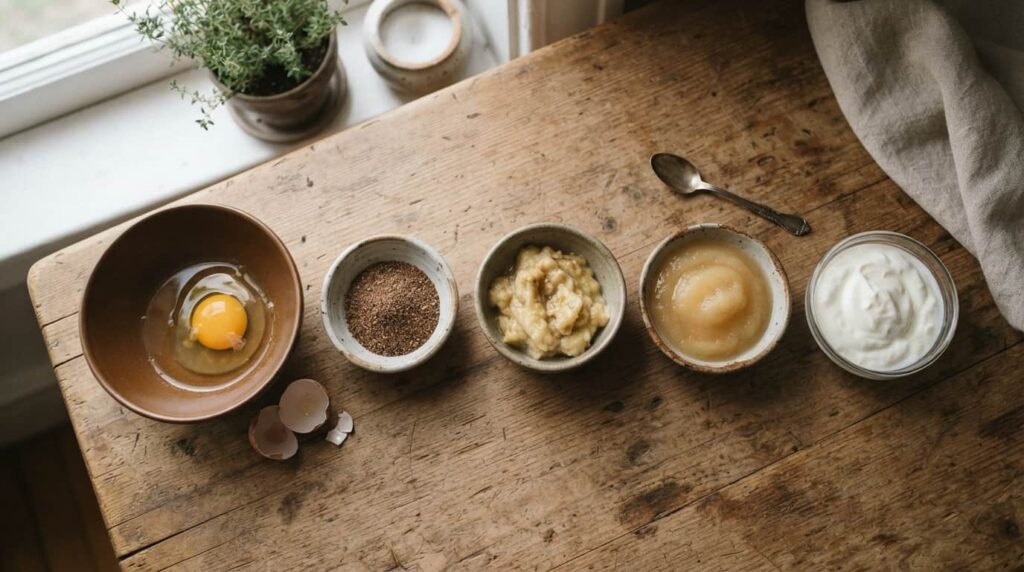
Substitute for Eggs in Baking: 10 Easy Swaps That Work
Running out of eggs does not always mean abandoning the recipe halfway through. The right substitute for eggs in baking can keep your cookies, muffins, cakes, brownies, and quick breads on track—you just need to match the substitute to the job the egg was supposed to do.
For a typical recipe, ground flaxseed, applesauce, yogurt, mashed banana, aquafaba, and commercial egg replacers are among the most useful options. But they do not behave the same way. Flaxseed is good at binding, applesauce adds moisture, yogurt gives tenderness, and aquafaba can mimic some of the properties of egg whites.
That distinction matters.
An egg is not just a wet ingredient. It can bind ingredients together, add moisture and fat, help a batter rise, create structure as it cooks, and contribute to browning. When you remove it, the best replacement depends on which of those jobs matters most in your recipe.
I learned this the practical way after treating egg substitutes as interchangeable. A swap that worked beautifully in muffins could make cookies too soft, while the same amount of fruit puree could leave a cake heavier than expected. The more useful approach is to look at the recipe first, then choose the substitute.
What Is the Best Substitute for Eggs in Baking?
If you need one dependable option for everyday baking, plain yogurt is a good choice for cakes, muffins, and brownies, while a flax egg is especially useful for cookies and quick breads.
Here is the quick guide:
| Egg substitute | Amount to replace 1 egg | Best uses | What to expect |
|---|---|---|---|
| Ground flaxseed + water | 1 tbsp flax + 2½–3 tbsp water | Cookies, muffins, quick breads | Good binding, slightly nutty |
| Chia seed + water | 1 tbsp chia + 3 tbsp water | Cookies, bars, brownies | Strong binding, slightly textured |
| Unsweetened applesauce | ¼ cup | Cakes, muffins, quick breads | Moist and soft |
| Mashed banana | ¼ cup | Banana bread, muffins, pancakes | Moist with noticeable banana flavor |
| Plain yogurt | ¼ cup | Cakes, brownies, muffins | Tender, moist crumb |
| Silken tofu | ¼ cup pureed | Brownies, dense cakes, bars | Moist and fairly neutral |
| Aquafaba | 3 tbsp | Cookies, cakes, meringue-style recipes | Light and useful for egg-white applications |
| Baking soda + vinegar | 1 tsp baking soda + 1 tbsp vinegar | Light cakes, quick breads | Adds lift but little binding |
| Buttermilk | ¼ cup | Cakes, muffins | Tender and slightly tangy |
| Commercial egg replacer | Follow package directions | General baking | Convenient and predictable |
These amounts are starting points rather than universal rules. A recipe with three or four eggs is much harder to convert than one that calls for a single egg.
Why Are Eggs So Important in Baking?
Before choosing an egg substitute, look at what the eggs are doing in the original recipe.
Eggs provide structure
When eggs are heated, their proteins set and help give baked goods their shape. This is one reason a cake can hold together after coming out of the oven.
Eggs help bind ingredients
Eggs help flour, sugar, fat, and other ingredients stay together. This matters particularly in cookies, bars, meatless patties, and other mixtures where you need ingredients to hold their shape.
Eggs add moisture
Eggs contain a significant amount of water, so removing them can make a recipe dry unless the replacement supplies enough moisture.
Eggs can help with leavening
Beaten eggs can trap air. In recipes that rely heavily on whipped eggs, such as some sponge cakes, simply adding applesauce or yogurt will not reproduce the same effect.
Egg yolks add richness
The yolk contains fat and emulsifying compounds that help create a richer, smoother texture. A substitute can replace some of that moisture and tenderness without completely reproducing the behavior of a yolk.
This is why there is no single “best” egg substitute for every baked good.
How Do You Choose the Right Egg Substitute?
Start with the recipe instead of the substitute.
Ask yourself three questions:
-
Does the recipe need the egg mainly for binding?
-
Does it need extra moisture and tenderness?
-
Does it depend on eggs for significant lift or structure?
For a chewy cookie, I would reach for a flax egg before applesauce. For a soft muffin, applesauce or yogurt makes more sense. For a brownie, yogurt, silken tofu, or flax can all work depending on the texture you want.
If the recipe calls for several eggs and is designed around whipped eggs, be more cautious. That is not the place to make a simple one-for-one substitution and expect the original result.
10 Reliable Substitutes for Eggs in Baking
1. Ground Flaxseed: Best for Binding
A flax egg is one of the most useful egg replacements for everyday baking.
Mix:
1 tablespoon ground flaxseed + 2½ to 3 tablespoons water = 1 egg
Let the mixture sit for about 5 to 10 minutes until it becomes thick and gel-like.
Ground flaxseed works particularly well in:
-
Cookies
-
Muffins
-
Brownies
-
Quick breads
-
Oat bars
The gel helps hold ingredients together, much like an egg used for binding.
The main downside is flavor. Flax has a mild nutty taste, so you may notice it in delicate vanilla or lightly flavored baked goods.
Tip: Use finely ground flaxseed rather than whole seeds. Whole flax does not create the same gel.
2. Chia Seed: A Strong Binder
Chia seeds work in much the same basic way as flaxseed because they absorb water and form a gel.
Use:
1 tablespoon chia seeds + 3 tablespoons water = 1 egg
Allow the mixture to thicken before adding it to the batter.
Chia works well in brownies, cookies, bars, and hearty muffins. It is especially useful when the finished texture does not need to be perfectly smooth.
There is one obvious drawback: chia seeds can remain visible in the baked product. If you want an invisible substitute in a pale cake, this probably is not your first choice.
3. Applesauce: Great for Moist Cakes and Muffins
Use:
¼ cup unsweetened applesauce = 1 egg
Applesauce is one of the easiest substitutes because it adds moisture and gives baked goods a soft texture.
It works particularly well in:
-
Muffins
-
Quick breads
-
Snack cakes
-
Soft cookies
-
Some brownies
Choose unsweetened applesauce when possible. Sweetened applesauce adds extra sugar, which can affect the final sweetness.
Applesauce does not provide the same binding and structure as a real egg, so recipes with multiple eggs may need additional adjustments.
If the batter already seems very wet, avoid adding extra liquid just because the original recipe included eggs.
4. Mashed Banana: Best When Banana Flavor Fits
Use:
¼ cup mashed ripe banana = 1 egg
Banana is useful when you want a moist, soft baked good and do not mind its flavor.
It is particularly good in:
-
Banana bread
-
Muffins
-
Pancakes
-
Oatmeal cookies
-
Breakfast bars
The riper the banana, the easier it is to mash and the stronger its flavor will be.
I would not use banana as the first choice for a delicate vanilla cake unless you actually want a hint of banana. The flavor can be difficult to hide.
5. Plain Yogurt: A Versatile Choice
Use:
¼ cup plain yogurt = 1 egg
Plain yogurt is a practical option for cakes, muffins, and brownies because it adds moisture and tenderness.
Greek yogurt can also work, although its thicker consistency means the batter may behave slightly differently from one made with regular yogurt.
Choose plain, unsweetened yogurt. Flavored yogurt can introduce extra sugar, fruit flavor, or other ingredients that change the recipe.
Yogurt is particularly useful when the recipe already contains baking soda or another leavening ingredient. Its acidity can contribute to the chemical reactions that help some batters rise, although it does not replace all the functions of an egg.
6. Silken Tofu: Good for Dense, Moist Bakes
Pureed silken tofu can replace eggs in recipes where a dense, moist texture is acceptable.
Use:
¼ cup pureed silken tofu = 1 egg
It can work well in:
-
Brownies
-
Dense cakes
-
Chocolate desserts
-
Bars
-
Some quick breads
The key is to blend it until smooth. Small chunks of tofu are not what you want in a cake batter.
Because tofu does not provide the same leavening action as whipped eggs, it is better suited to dense desserts than airy sponge cakes.
7. Aquafaba: The Egg-White Specialist
Aquafaba is the liquid from cooked chickpeas, commonly obtained from canned chickpeas.
A general starting point is:
3 tablespoons aquafaba = 1 egg
Its most interesting quality is that it can be whipped and used in applications where egg whites are important.
Aquafaba can be useful for:
-
Meringue-style desserts
-
Some cookies
-
Macaron-style preparations
-
Light baked goods
-
Vegan recipes
For recipes that depend on whipped egg whites, aquafaba is one of the more appropriate substitutes to investigate. However, results can vary depending on the aquafaba’s thickness and the recipe.
If using canned chickpeas, strain the liquid carefully and avoid adding chickpea solids to the mixture.
8. Baking Soda and Vinegar: For Extra Lift
A mixture of baking soda and vinegar is useful when an egg’s main job is helping a batter become lighter.
A common starting ratio is:
1 teaspoon baking soda + 1 tablespoon vinegar = 1 egg
The acid and baking soda react to produce carbon dioxide, which can help create lift.
But there is an important limitation: this combination does not replace an egg’s binding, richness, or structure.
That makes it more useful in a simple cake or quick bread than in a cookie that needs an egg to hold everything together.
9. Buttermilk: Useful in Cakes and Muffins
Use:
¼ cup buttermilk = 1 egg
Buttermilk adds liquid, acidity, and tenderness. It can be useful in muffins and cakes, particularly recipes that already use baking soda.
However, like applesauce and yogurt, buttermilk is not a complete replacement for every function of an egg.
Because it adds liquid, check the consistency of your batter before adding any additional milk or water called for in the recipe.
10. Commercial Egg Replacer: Convenient for General Baking
A packaged egg replacer can be the easiest choice when you do not want to experiment.
Different products have different ingredients and instructions, so follow the package directions rather than assuming every brand uses the same ratio.
Commercial replacers can be particularly convenient for people who regularly bake without eggs because you can keep the product in the pantry and use it as needed.
For a recipe you are making for the first time, however, it is still worth checking whether the product is intended for cakes, cookies, or other specific applications.
What Is the Best Egg Substitute for Cookies?
For most cookies, flax eggs are a strong starting point because cookies often need binding more than they need dramatic lift.
A flax egg can help keep the dough together while maintaining a chewy texture.
Applesauce is another option, but expect a softer cookie. It can push a cookie toward a more cake-like texture.
Banana works when its flavor fits the recipe, especially in oatmeal or breakfast-style cookies.
If you are making a crisp cookie, be more careful with high-moisture substitutes. Adding extra moisture can change spreading and crispness.
Best choices: flax egg, chia egg, or a commercial egg replacer.
What Is the Best Substitute for Eggs in Cake?
For ordinary cakes, plain yogurt or applesauce can be useful starting points.
Yogurt tends to give a tender, moist crumb without adding a strong flavor. Applesauce can also work well but may make the cake softer and slightly denser.
The biggest challenge is lift.
If the original cake gets much of its structure from several eggs, replacing them with one wet ingredient may not be enough. Recipes designed specifically for egg-free baking are usually easier to convert successfully because the flour, liquid, fat, and leavening have already been balanced.
For a simple one-egg cake, however, substitution is generally much easier.
What Can I Use Instead of Eggs in Brownies?
Brownies are among the easiest baked goods to adapt because many people actually prefer a dense, fudgy texture.
Good options include:
-
Plain yogurt
-
Flax egg
-
Silken tofu
-
Applesauce
-
Chia egg
For fudgy brownies, I would avoid choosing a substitute solely because it adds lots of lift. The goal is usually moisture and structure rather than a tall, airy crumb.
Chocolate also helps hide stronger flavors. That makes brownies a forgiving place to experiment with flaxseed or tofu.
Can I Replace Eggs in a Boxed Cake Mix?
Yes, but the best method depends on the cake mix and the number of eggs it calls for.
For a boxed cake mix requiring eggs, a commercial egg replacer is one straightforward option. Applesauce or yogurt can also work, but they may produce a slightly different crumb.
Avoid adding several tablespoons of extra liquid without considering the other ingredients already in the mix. Cake batter that becomes too wet may bake slowly in the center while the outside looks finished.
If you are making the cake for an important event, test the substitution once before serving it to guests.
Which Egg Substitute Is Best for Vegan Baking?
For vegan baking, avoid dairy-based options such as yogurt and buttermilk.
Useful choices include:
-
Flaxseed
-
Chia seeds
-
Applesauce
-
Mashed banana
-
Aquafaba
-
Silken tofu
-
Vegan commercial egg replacers
The choice still depends on the recipe.
For example, flax is useful for a cookie that needs binding, while aquafaba makes more sense when you are trying to reproduce an egg-white function.
Also check the other ingredients in the recipe. Replacing the eggs does not automatically make the entire baked good vegan.
What If I Am Baking for an Egg Allergy?
If eggs must be avoided because of an allergy, do not treat the substitute as the only thing you need to check.
Read ingredient labels on packaged ingredients, particularly products such as chocolate, cake mixes, baking mixes, and prepared toppings. Cross-contact can also matter depending on the severity of the allergy and the kitchen environment.
For a serious allergy, use an egg-free recipe from a reliable source when possible rather than making major substitutions to a recipe built around several eggs.
A simple one-egg cookie is usually much easier to adapt than an egg-heavy sponge cake.
Why Did My Egg-Free Cake Turn Out Dense?
A dense cake does not necessarily mean the substitute “failed.” It may mean the replacement handled one function of the egg but not another.
Here are common causes:
Too much moisture: Applesauce, yogurt, banana, and other wet substitutes can make the batter heavy.
Not enough leavening: A substitute may provide moisture and binding but no meaningful lift.
The recipe depended on whipped eggs: Some cakes rely heavily on air incorporated into beaten eggs.
Too many eggs were replaced at once: Replacing three or four eggs is more difficult than replacing one.
Overmixing: Once flour is incorporated, excessive mixing can make some baked goods heavier or tougher.
When adapting a recipe, make small changes rather than changing several ingredients at the same time. That makes it much easier to identify what caused a problem.
Can You Use Water Instead of Eggs?
Not by itself in most baking recipes.
Water can replace some of the liquid lost when eggs are removed, but it does not provide the binding, structure, fat, or other properties that eggs contribute.
That is why simply adding water often produces a mixture that looks fine before baking but falls apart or turns out dense afterward.
If the recipe only needs a small amount of moisture, water may be part of a broader substitution, but it should not generally be treated as a complete egg replacement.
A Simple Way to Substitute Eggs Without Ruining the Recipe
When I am unsure about a recipe, this is the approach I would take:
Step 1: Count the eggs
Replacing one egg is much easier than replacing four.
Step 2: Identify the type of baked good
A cookie, brownie, muffin, and sponge cake have very different needs.
Step 3: Choose the main function
Ask whether the egg is primarily providing binding, moisture, richness, or lift.
Step 4: Pick the least disruptive substitute
For a vanilla muffin, plain yogurt may be less noticeable than banana. For an oatmeal cookie, flax may fit naturally.
Step 5: Watch the batter
Do not automatically add every liquid listed in the recipe if your substitute already adds substantial moisture.
Step 6: Bake a test batch when the result matters
This is especially worthwhile for birthday cakes, holiday desserts, or recipes you plan to make repeatedly.
Egg Substitute Mistakes to Avoid
The biggest mistake is assuming that all egg substitutes are interchangeable.
A few other problems come up often:
Using banana when you do not want banana flavor. It can work technically while still giving you a dessert that tastes completely different.
Using too much fruit puree. More is not necessarily better. Extra moisture can make the center gummy or heavy.
Expecting flax or chia to create a fluffy cake. They are excellent binders, but they do not reproduce whipped eggs.
Forgetting sweetness. Banana and applesauce can change the sweetness of a recipe.
Ignoring the original recipe’s liquid balance. A wet substitute may require adjustments elsewhere.
Replacing several eggs in a delicate recipe without testing. Some recipes are simply poor candidates for casual substitution.
Quick Decision Guide
If you need an egg substitute right now, use this as your starting point:
-
Cookies: flax egg or chia egg
-
Muffins: applesauce, yogurt, or flax egg
-
Quick breads: applesauce, banana, yogurt, or flax
-
Brownies: yogurt, flax, tofu, or applesauce
-
Dense cakes: yogurt or silken tofu
-
Vegan baking: flax, chia, aquafaba, tofu, fruit puree, or commercial replacer
-
Egg-white-style recipes: aquafaba
-
Recipes needing extra lift: consider baking soda + vinegar alongside another substitute
-
Delicate sponge cakes: use an egg-free recipe designed for that purpose when possible
How much applesauce replaces one egg?
Use about ¼ cup of unsweetened applesauce for one egg. It works best in moist baked goods such as muffins, quick breads, and some cakes.
How much yogurt replaces one egg?
A common starting point is ¼ cup plain yogurt for one egg. Regular or Greek yogurt can work, although Greek yogurt is thicker and may affect batter consistency.
What is the easiest vegan substitute for one egg?
For many everyday recipes, a flax egg is one of the easiest options: mix 1 tablespoon ground flaxseed with about 2½–3 tablespoons water and let it thicken before using.
Can I replace eggs with oil?
Oil does not provide the same binding or structure as an egg. It can replace some of the fat contributed by a yolk, but it should not usually be used as a complete egg substitute by itself.
Can I use banana instead of eggs?
Yes. Use about ¼ cup mashed ripe banana per egg. It works especially well in banana bread, muffins, and other recipes where the banana flavor fits.
What is the best egg substitute for brownies?
Plain yogurt, flax eggs, silken tofu, and applesauce can all work. For a fudgy brownie, choose a substitute that provides moisture and binding rather than focusing only on lift.
Can I replace multiple eggs with one substitute?
Sometimes, but the difficulty increases as the number of eggs increases. A recipe containing several eggs may rely heavily on their structure and aeration, so a simple one-for-one swap may not reproduce the original result.
What is the best egg substitute for baking overall?
There is no single winner for every recipe. Flax eggs are excellent for binding, yogurt is versatile for moist cakes and muffins, applesauce is useful for soft baked goods, and aquafaba is the better choice when egg-white behavior matters.
The safest choice is the one that matches the job the egg was doing in the recipe. Once you start thinking about eggs as a combination of binder, moisture source, structural ingredient, and leavener, choosing a substitute becomes much less of a guessing game.



Pingback: Gluten Free Pancake Recipe: Light and Fluffy
Pingback: Egg Substitute for Baking: 10 Reliable Swaps and Exact Ratios - kitchennista.com
Pingback: Best Egg Substitute for Cake: 9 Swaps That Work (2026)