4 oz Chicken Breast: Calories, Protein, Weight, and How to Cook It
If you’re tracking protein, planning meals, or simply trying to figure out what a serving of chicken actually looks like, 4 oz chicken breast is a useful portion to understand.
The problem is that “4 ounces of chicken” can mean two different things: 4 ounces weighed raw or 4 ounces weighed after cooking. Those are not nutritionally identical portions because chicken loses water as it cooks.
A 4-ounce raw, boneless, skinless chicken breast is roughly 113 grams and generally provides around 120–140 calories and about 25–26 grams of protein. If you weigh 4 ounces after cooking, the same weight contains more protein and calories per ounce because some of the chicken’s water has already been removed.
That small distinction can make a noticeable difference when you’re meal prepping several portions or entering food into a calorie-tracking app.
This guide explains exactly how to measure a 4 oz chicken breast, how raw and cooked weights compare, what the nutrition looks like, and the easiest ways to cook a small chicken breast without drying it out.
What Does 4 oz of Chicken Breast Look Like?
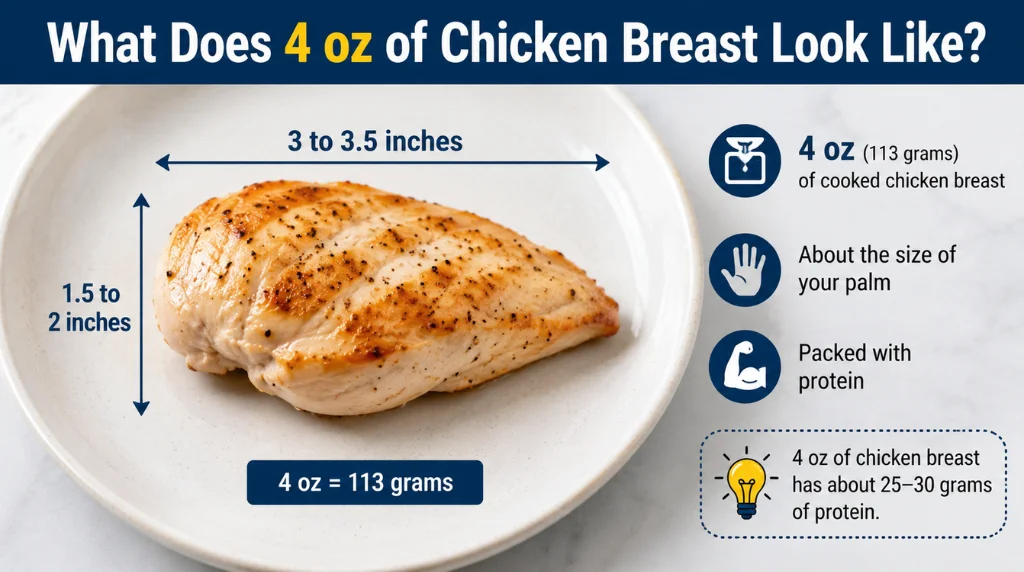
Four ounces of chicken breast is about 113 grams. Visually, a raw 4-ounce portion is usually close to the size of an adult palm, although thickness and shape can vary considerably.
It’s also often compared with the size of a deck of cards. These visual comparisons are useful when you’re eating at a restaurant or don’t have a scale, but they’re only estimates.
A chicken breast from the grocery store is often much larger than 4 ounces. A single boneless, skinless breast may weigh 6, 8, 10 ounces, or even more. So if you’re following a meal plan that calls for 4 ounces, don’t assume the entire breast is one serving.
The most reliable method is simple:
-
Put a kitchen scale on a flat surface.
-
Set it to ounces or grams.
-
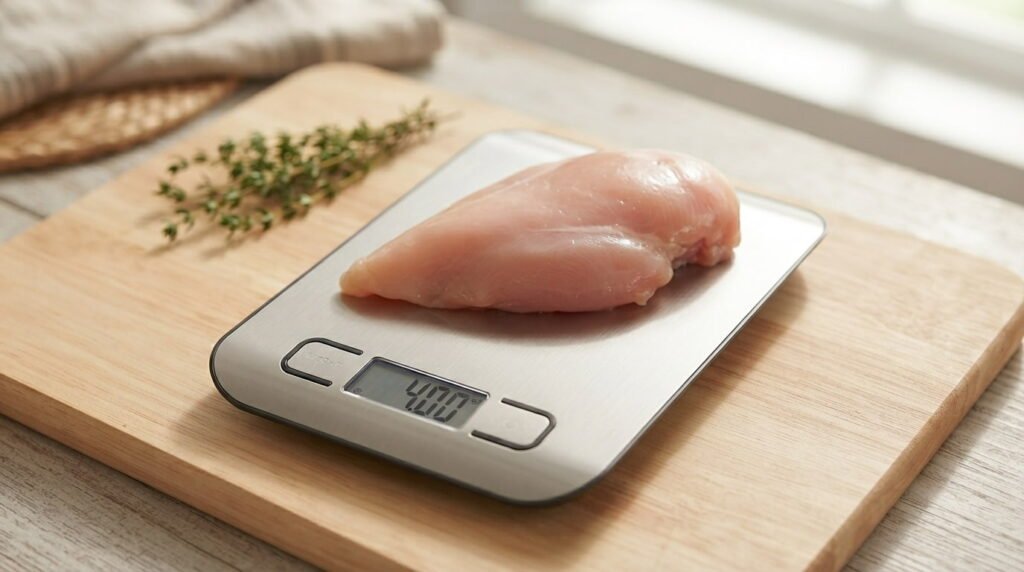
Place the raw chicken on the scale.
-
Stop when it reaches about 4 oz or 113 g.
-
Record the weight before cooking if you’re using raw nutrition information.
For meal prep, I find weighing several portions at once much easier than trying to estimate each piece by eye. Once the portions are separated, cooking becomes much more predictable.
Is 4 oz Chicken Breast Measured Raw or Cooked?
This is the biggest source of confusion.
Four ounces raw and four ounces cooked are different portions of chicken.
Chicken contains a significant amount of water. During baking, grilling, pan-searing, or air frying, some of that water evaporates. The cooked chicken therefore weighs less than it did when raw.
For example, imagine you start with:
4 oz raw chicken → approximately 3 oz cooked chicken
The exact amount of weight lost isn’t fixed. A thin breast cooked quickly may lose a different amount of water than a thicker breast cooked for longer.
Now consider the opposite situation:
4 oz cooked chicken
To end up with 4 ounces on the scale after cooking, you generally need to start with more than 4 ounces raw.
This is why two nutrition apps can give you different numbers for “4 oz chicken breast” without either one necessarily being wrong.
The easiest way to avoid the confusion
Choose one method and stay consistent.
If your food database gives nutrition information for raw chicken breast, weigh your chicken raw and enter the raw amount.
If you’re following a recipe that specifically gives nutrition for cooked chicken, weigh the finished chicken and use the cooked entry.
Don’t weigh the chicken raw and then enter 4 oz cooked chicken into your tracker. That’s where the numbers start drifting.
USDA FoodData Central provides separate food records and nutrient information for foods in different states, including raw chicken breast, which is one reason checking whether an entry says “raw” or “cooked” matters.
How Many Calories Are in 4 oz Chicken Breast?
For 4 oz of raw, boneless, skinless chicken breast, a reasonable estimate is around 120–140 calories.
The exact number varies somewhat with the particular chicken and the nutrition database you’re using.
A 4 oz cooked portion is usually higher in calories by weight, commonly landing around 165–190 calories for plain boneless, skinless chicken breast.
That doesn’t mean cooking magically creates calories. The difference mostly comes from water loss.
Think of it this way:
-
Raw chicken contains protein, fat, and a lot of water.
-
Cooking removes some of that water.
-
The chicken becomes lighter.
-
The remaining nutrients are packed into fewer ounces.
So comparing 4 oz raw with 4 oz cooked is not an apples-to-apples comparison.
What changes the calorie count even more?
The chicken itself is only part of the equation.
A plain grilled chicken breast can stay relatively lean, while these additions can raise the calorie total:
-
Olive oil or other cooking oil
-
Butter
-
Cream-based sauces
-
Breaded coatings
-
Sugary marinades
-
Cheese
-
Thick barbecue or honey-based sauces
For example, brushing a chicken breast with oil before roasting doesn’t make the chicken itself higher in calories because of cooking; the added oil is what needs to be counted.
If you’re tracking calories closely, measure the oil rather than pouring it freely into the pan.
How Much Protein Is in 4 oz Chicken Breast?
A 4 oz raw chicken breast provides roughly 25–26 grams of protein.
A 4 oz cooked portion generally provides around 34–35 grams of protein, depending on the cooking method and the specific chicken.
Again, the difference comes primarily from water loss and the fact that you’re comparing equal weights rather than the same physical piece before and after cooking.
The protein itself doesn’t suddenly increase during cooking.
This distinction is particularly useful when meal prepping. Suppose you cook a batch of chicken and divide the finished meat into four-ounce containers. Those containers can have considerably more protein per ounce than four-ounce raw portions because the cooked chicken has lost water.
For a person who simply wants a convenient high-protein meal, 4 oz is a practical serving. Someone with a higher protein target may choose 5, 6, or 8 ounces instead.
There isn’t one universally correct chicken portion for every person. Your overall food intake and individual nutritional needs determine how much makes sense.
4 oz Chicken Breast Nutrition Facts
The following figures are useful general estimates for plain, boneless, skinless chicken breast. Actual nutrition can vary by product and by whether the chicken is raw or cooked.
| Nutrient | 4 oz Raw | 4 oz Cooked |
|---|---|---|
| Weight | 113 g | 113 g |
| Calories | ~120–140 | ~165–190 |
| Protein | ~25–26 g | ~34–35 g |
| Carbohydrates | 0 g | 0 g |
| Fat | ~2–4 g | ~4–6 g |
| Saturated fat | Low | Low |
| Sodium | Naturally low, but varies | Varies |
These numbers are for plain chicken breast, not breaded chicken, deli chicken, or chicken prepared with substantial oil or sauce.
The USDA notes that food portions and nutrient values can vary by the particular FoodData Central data type and food record, so nutrition databases should be treated as reference points rather than a guarantee for every package of chicken.
How Many Grams Is 4 oz of Chicken?
Four ounces is approximately:
4 oz = 113 grams
For everyday meal prep, you can round it to 113 g.
If your kitchen scale only displays grams, 113 g is the number to look for when portioning 4 oz.
Here are a few useful conversions:
| Chicken Weight | Approximate Grams |
|---|---|
| 2 oz | 57 g |
| 3 oz | 85 g |
| 4 oz | 113 g |
| 5 oz | 142 g |
| 6 oz | 170 g |
| 8 oz | 227 g |
This becomes especially handy when you’re following recipes written in grams but your meal plan uses ounces.
How to Cook a 4 oz Chicken Breast So It Stays Juicy
Small chicken breasts can go from perfectly cooked to dry surprisingly quickly.
The trick isn’t simply “cook it for exactly X minutes.” Thickness, starting temperature, pan type, and cooking method all affect the cooking time.
The most reliable approach is to cook by internal temperature rather than the clock.
For chicken, the safe internal temperature is 165°F (74°C). Use an instant-read thermometer in the thickest part of the breast.
Oven-baked 4 oz chicken breast
For a small portion, baking is straightforward.
-
Heat the oven to about 425°F.
-
Pat the chicken dry with paper towels.
-
Lightly coat it with oil if desired.
-
Season both sides.
-
Place it on a baking sheet or small baking dish.
-
Begin checking the temperature after roughly 10–12 minutes.
-
Remove it when the thickest part reaches 165°F.
-
Let it rest for a few minutes before slicing.
The exact cooking time depends heavily on thickness, so don’t treat 12 or 15 minutes as a guarantee.
If the breast is thick in the middle and very thin at the edges, gently pounding it to a more even thickness can make a bigger difference than changing the oven temperature.
Air fryer
An air fryer works particularly well for small portions because it heats quickly and doesn’t require a large amount of oil.
Try around 380°F and begin checking a 4-ounce breast after approximately 7–9 minutes, turning it halfway through if needed.
The thermometer should still make the final decision.
A small chicken breast can overcook quickly in an air fryer, so adding several extra minutes “just to be safe” is one of the easiest ways to end up with dry meat.
Stovetop chicken breast
For pan-searing, thickness matters.
If the breast is uneven, pound it gently until the thickest section is closer in thickness to the thinner areas.
Heat a skillet over medium to medium-high heat, add a small amount of oil, and cook the chicken until browned and cooked through. Depending on thickness, this can take several minutes per side.
Check the thickest part with a thermometer rather than cutting into the chicken repeatedly.
Cutting the breast open several times to check for doneness releases juices and still doesn’t tell you the exact internal temperature.
Why Does My 4 oz Chicken Breast Come Out Dry?
Usually, one of three things happened:
1. It was cooked too long
Chicken breast is lean, so there isn’t much fat available to compensate for overcooking.
Once it has reached the safe internal temperature, continuing to cook it for several more minutes can make the texture noticeably drier.
2. The breast was uneven
A thick center takes longer to cook than thin edges.
By the time the middle is done, the edges may already be overcooked.
Pounding the breast evenly is a simple fix.
3. You guessed instead of measuring
This is probably the most common problem.
A 4-ounce chicken breast isn’t necessarily the same thickness as another 4-ounce chicken breast. Weight tells you how much chicken you have, but it doesn’t tell you exactly how quickly heat will reach the center.
That’s why a thermometer is more useful than memorizing a cooking time.
Can You Cook a 4 oz Chicken Breast From Frozen?
Yes, chicken can be cooked from frozen, but the cooking process will take longer and the results can be less predictable than starting with thawed chicken.
If you frequently prepare small chicken portions, thawing them safely in the refrigerator ahead of time generally makes portioning and cooking easier.
Avoid relying on appearance alone to determine whether frozen chicken is fully cooked. The thickest section should reach 165°F.
For meal prep, I prefer planning the thawing step ahead rather than trying to rush a frozen breast into dinner. It makes seasoning easier and reduces the temptation to overcook the outside while waiting for the center to finish.
How Do You Measure 4 oz Chicken Without a Scale?
Your palm can provide a rough visual estimate, but it shouldn’t be considered an exact measurement.
Hand sizes vary, and chicken breasts have very different shapes.
If you’re casually eating a balanced meal, estimating a portion by hand is perfectly practical. If you’re tracking calories or protein closely, use a digital kitchen scale.
A scale also makes meal prep much faster once you get into the habit.
Instead of repeatedly guessing, you can place several containers on the scale, portion the chicken, and quickly create consistent servings.
Should You Weigh Chicken Before or After Cooking?
For the most consistent tracking, weigh it in the same state as the nutrition entry you’re using.
If the package or database provides values per 100 g raw chicken, weigh the raw chicken.
If your recipe specifically provides nutrition based on cooked weight, weigh the cooked chicken.
For someone starting from scratch, raw weighing is often easier because you can portion the chicken before cooking and use the raw nutrition information consistently.
The key isn’t that raw weighing is magically more accurate. The key is consistency.
If you cook a large batch and then weigh cooked portions, that’s also workable. Just use a cooked chicken entry when logging the food.
Is 4 oz Chicken Breast Enough for a Meal?
It can be, especially when the chicken is served with other foods.
A 4-ounce portion can provide roughly 25 grams of protein before cooking, while a 4-ounce cooked portion is more concentrated by weight.
But chicken doesn’t have to be the entire meal.
For example, a 4 oz chicken breast can be paired with:
-
Rice and roasted vegetables
-
Potatoes and green beans
-
A large salad
-
Whole-grain pasta
-
Beans and vegetables
-
Tortillas for chicken tacos
If you’re still hungry after a 4-ounce serving, increasing the amount of vegetables, adding a carbohydrate source, or simply using a larger chicken portion may make more sense than trying to make a small breast feel like a complete meal.
Common Mistakes When Measuring 4 oz Chicken
Mistake 1: Confusing raw and cooked weight
This is the big one.
Always check whether your nutrition entry says raw, roasted, grilled, or cooked.
Mistake 2: Counting the entire chicken breast as 4 oz
Large grocery-store breasts often contain multiple 4-ounce portions.
Weigh them rather than assuming.
Mistake 3: Forgetting cooking oil
Chicken can be very lean, but the oil used in the pan still contributes calories.
Measure it if accurate tracking matters.
Mistake 4: Cooking every breast for the same amount of time
Two breasts can weigh the same but have different thicknesses.
Use internal temperature as your final check.
Mistake 5: Cutting the chicken immediately
Allowing the cooked breast to rest briefly before slicing can help it retain more of its juices.
A Simple 4 oz Chicken Meal-Prep Method
If you’re preparing several meals for the week, keep the process simple.
Start with enough boneless, skinless chicken breasts to create your desired number of portions. Trim them if necessary, then weigh the raw meat.
For four-ounce portions, aim for about 113 g raw per portion.
Season with salt, pepper, garlic powder, paprika, or another blend you enjoy. Place the chicken on a baking sheet and cook until the thickest part reaches 165°F.
After cooking, let the chicken rest before slicing.
If you’re tracking nutrition, don’t switch between raw and cooked measurements halfway through your meal-prep routine. Pick one system and use it for the whole batch.
One practical lesson from portioning chicken this way is that consistency matters more than chasing an exact number on every individual piece. A portion that is 4.0 ounces one day and 4.1 ounces another day isn’t the problem. The bigger problem is weighing raw chicken one day and logging cooked chicken the next.
The Bottom Line
A 4 oz chicken breast is about 113 grams, but the nutrition depends on whether you weigh it before or after cooking.
For a simple reference, 4 oz raw boneless, skinless chicken breast provides roughly 120–140 calories and 25–26 grams of protein. A 4 oz cooked portion is more concentrated and commonly provides around 165–190 calories and 34–35 grams of protein.
If you’re meal prepping or tracking macros, the easiest system is to weigh the chicken consistently and make sure your nutrition entry matches the state of the chicken—raw or cooked.
And when it comes to cooking, don’t let the clock be your only guide. Chicken breasts vary in thickness, so an instant-read thermometer is a much better way to know when your 4 oz portion is ready.
How many calories are in a 4 oz chicken breast?
A 4 oz raw, boneless, skinless chicken breast generally contains around 120–140 calories. A 4 oz cooked portion is commonly around 165–190 calories because cooking removes water.
How much protein is in 4 oz of chicken breast?
Four ounces of raw chicken breast contains roughly 25–26 grams of protein. Four ounces of cooked chicken breast is typically around 34–35 grams, depending on moisture loss and the specific product.
How many grams is 4 oz chicken breast?
Four ounces equals approximately 113 grams.
Is 4 oz of chicken breast a good serving size?
Four ounces is a practical portion for many meals, but serving size depends on the rest of the meal and your individual nutrition needs. Some people prefer larger portions when they need more protein or simply have a bigger appetite.
Does chicken breast lose calories when cooked?
Not necessarily. Cooking primarily removes water. Because the chicken weighs less afterward, the calories and protein become more concentrated per ounce.
How much does a 4 oz chicken breast shrink when cooked?
There isn’t one exact amount. Water loss depends on cooking temperature, time, thickness, and method. A 4 oz raw portion may finish at around 3 oz cooked, but actual results vary.
Can I use my palm to measure 4 oz of chicken?
Yes, as a rough estimate. A 4 oz portion is often close to the size of an adult palm, but hand size and chicken thickness vary. Use a kitchen scale when precision matters.
What is the best way to cook a small chicken breast?
For convenience, baking and air frying are both good options. The most important step is checking the thickest part with a thermometer and cooking the chicken to 165°F rather than relying only on a fixed cooking time.
Why does my chicken breast get rubbery?
Overcooking is a common reason. Uneven thickness can also cause the thin parts to become overdone while you wait for the center to cook. Flattening the breast to an even thickness and using a thermometer can help.
Is 4 oz chicken breast high in protein?
Yes. Plain chicken breast provides a substantial amount of protein for its weight, particularly when compared with many higher-fat protein foods. The exact protein amount depends on whether the 4 ounces are measured raw or cooked.