Healthy After School Snacks Kids Will Actually Eat (2026)
If you’re searching for healthy after school snacks that won’t get left half-eaten on the counter, you’re in the right place. The 3 p.m. hunger rush is real, and what your kids grab in that window can shape their energy, mood, and appetite for the rest of the day. Below you’ll find fruit and veggie combos, protein-packed picks, five-minute homemade options, and a few store-bought backups for the days you’re just trying to survive pickup and homework at the same time.
Why Healthy After School Snacks Matter More Than You’d Think
It’s easy to think of the after-school snack as a small thing, a little something to tide kids over. But it’s actually doing more work than that. Snacks eaten between lunch and dinner can make up close to a third of a child’s total calories for the day, which means the choices at that specific hour carry real weight.
A well-built snack does three jobs at once. It keeps blood sugar steady so kids aren’t crashing into meltdown mode before dinner. It gives their brains the fuel to power through homework. And over time, it quietly teaches them what a balanced bite looks like, which sticks with them longer than any single snack ever could.
Kids also tend to be hungrier than we expect in this window. Many eat lunch early in the school day, meaning by 3 p.m. they’re running on empty from six or more hours without food. That’s not a small appetite to fill with a granola bar alone.
What Makes a Snack Actually Healthy?
A healthy after-school snack pairs a carbohydrate with a protein or fat, so it actually holds kids over instead of leaving them hungry again in twenty minutes. Think apple slices with peanut butter, whole-grain crackers with cheese, or hummus with veggies, rather than a carb served alone.
The single biggest mistake parents make isn’t reaching for the “wrong” food, it’s reaching for only one food group. A plain handful of crackers or a piece of fruit by itself digests fast and leaves kids hunting for more before you’ve even started dinner. Pairing a carb with protein or healthy fat slows that digestion down and keeps them satisfied.
Fresh Fruit and Veggie Snacks Kids Grab Without Asking
The easiest way to get more produce into an after-school snack is to make it the path of least resistance. Kids reach for whatever’s already washed, cut, and sitting at eye level in the fridge, so a few minutes of prep on a Sunday pays off all week.
A few combinations that hold up well:
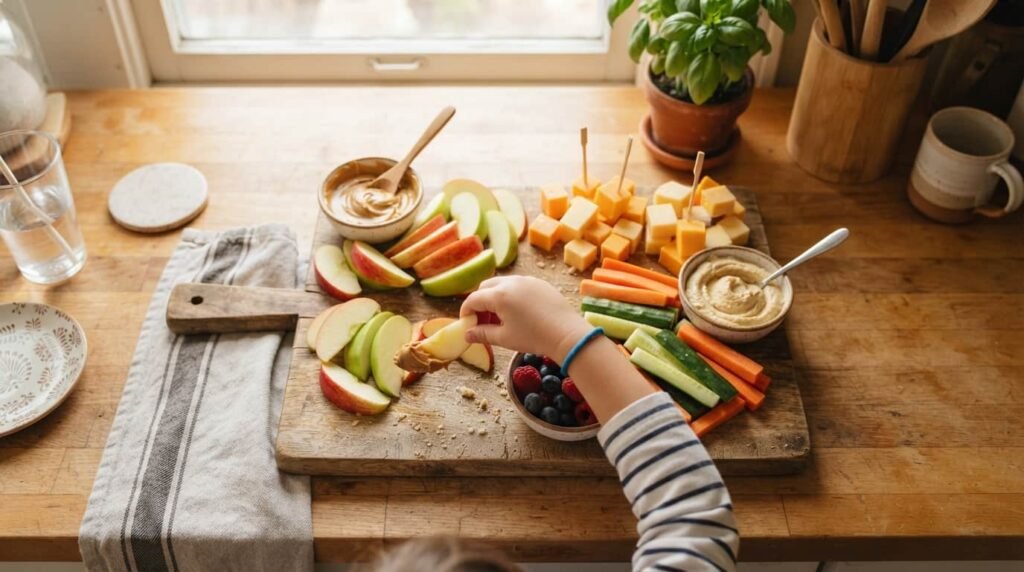
- Apple or pear slices with peanut butter or almond butter, plus a sprinkle of cinnamon
- Baby carrots, cucumber rounds, or bell pepper strips with hummus or a yogurt-based dip
- Berries, grapes, or orange segments mixed into a small bowl with a handful of nuts
- Celery sticks topped with peanut butter and raisins (the classic “ants on a log”)
- Frozen grapes or a fruit kabob threaded onto a skewer for a snack that feels more like an activity
Canned and frozen produce work just as well as fresh here, as long as you’re choosing fruit packed in its own juice rather than syrup, and vegetables without added salt. That’s a handy shortcut on weeks when fresh prep just isn’t happening.
Protein-Packed Snacks That Actually Hold Them Over
If your kid is the type who says they’re starving again fifteen minutes after a snack, protein is usually the missing piece. Protein and fiber slow down digestion, which is exactly what keeps energy steady between the last bell and dinner.
Some go-to options in this category:
- Hard-boiled eggs, sliced and served with whole-grain crackers
- String cheese or cheese cubes paired with fruit
- Greek yogurt topped with berries or a drizzle of honey, which also brings in gut-friendly probiotics
- A small turkey and cheese roll-up, or veggie pinwheels made with hummus and a whole-grain tortilla
- Age-appropriate nuts or a homemade trail mix with seeds, dried fruit, and a few whole-grain cereal pieces
In my own kitchen, the roll-ups are the one that disappears fastest, mostly because my kids like helping roll them themselves. Letting them build their own snack plate tends to get more of it eaten, not less.
Whole-Grain and Homemade Healthy After School Snacks (5-Minute Ideas)
Whole grains give kids the kind of steady, slow-burning energy that gets them through a homework session without a sugar crash halfway through. And homemade doesn’t have to mean complicated. Most of these come together in the time it takes to unpack a backpack.
- Whole-grain crackers with cheese or nut butter
- Whole-grain pretzels dipped in yogurt or hummus
- A mini whole-wheat English muffin pizza, topped with sauce, veggies, and a light layer of cheese, melted in the microwave
- A quick smoothie blended with fruit, a spoonful of yogurt, and a handful of spinach that basically disappears once it’s blended
- No-bake energy bites made from oats, nut butter, and a touch of honey, which store well for a week if you batch them
These are also the easiest snacks to make ahead. A Sunday batch of energy bites or muffins means you’re not starting from scratch at the hungriest hour of the day, which is honestly the hour none of us have patience for.
Healthy Store-Bought After School Snacks for Busy Weeks
Some weeks, homemade just isn’t happening, and that’s fine. The label is your best tool when you’re shopping for after-school snacks. Look for options that are lower in added sugar and sodium, and that list real ingredients near the top rather than a long string of additives.
Solid store-bought picks include:
- Single-serving yogurts or yogurt pouches
- String cheese paired with a piece of fruit
- Low-sugar whole-grain cereal, eaten dry or with milk
- Applesauce or fruit cups packed in juice, not syrup
- Whole-grain granola bars with minimal added sugar
- Jerky or turkey sticks for a protein-forward, portable option
Keeping a rotation of two or three of these on hand means there’s always something reasonable within reach, even on the days when nobody has the energy to prep.
Simple Tips for Building Better Snacking Habits
A few small habits make healthy after school snacks the easy default instead of a daily negotiation:
- Make the healthy choice the visible choice. Washed fruit on the counter and pre-cut veggies in clear containers get eaten far more than anything buried in the back of the fridge.
- Let kids help build the plate. Choosing their own combination, or picking a new fruit at the grocery store, makes them more invested in actually eating it.
- Batch-prep on a slower day. A Sunday spent chopping veggies, boiling eggs, or baking a batch of muffins means weekday snack time takes minutes, not effort.
- Save treats for treats. Cookies and sweets don’t need to disappear entirely, just keep them the occasional extra rather than the everyday default.
- Watch the clock, not just the plate. A snack served too close to dinner, no matter how healthy, can still take the edge off appetite. Aim for that one-to-two-hour buffer when you can.
None of this needs to be complicated. The families who make it through the after-school hour with the least drama are usually the ones who’ve simply made healthy snacks the easiest option in the house, not the ones with the fanciest recipes. Start with two or three ideas from this list, keep them stocked, and let the routine build itself from there
Answers to Common After-School Snack Questions
How many after-school snacks should kids have?
Younger kids generally do well with about two snacks a day in addition to three meals, while older kids and teens often need just one, or two if they’re very active or in a growth spurt. The goal is to offer a snack a few hours after one meal and at least an hour or two before the next, so it satisfies hunger without crowding out dinner.
What’s the easiest rule for building a healthy snack?
Pair a carbohydrate with a protein or fat. That’s the whole rule. Fruit with nut butter, crackers with cheese, veggies with hummus, this single pairing habit does more for keeping kids full than agonizing over any specific ingredient.
Are store-bought snacks ever okay?
Yes. A packaged snack with real ingredients and modest sugar is a completely reasonable choice on a busy day. The goal isn’t perfection at every single snack, it’s making sure whole, minimally processed foods are the default most of the time, with packaged convenience filling in the gaps.
How do I stop my kid’s snack from ruining their appetite for dinner?
Time it right and keep portions in check. Offer the snack roughly two hours before dinner, and lean toward lighter combinations, like fruit with a small amount of cheese, rather than something heavy and filling. If dinner is less than an hour away, a smaller bite or none at all is usually the better call.