
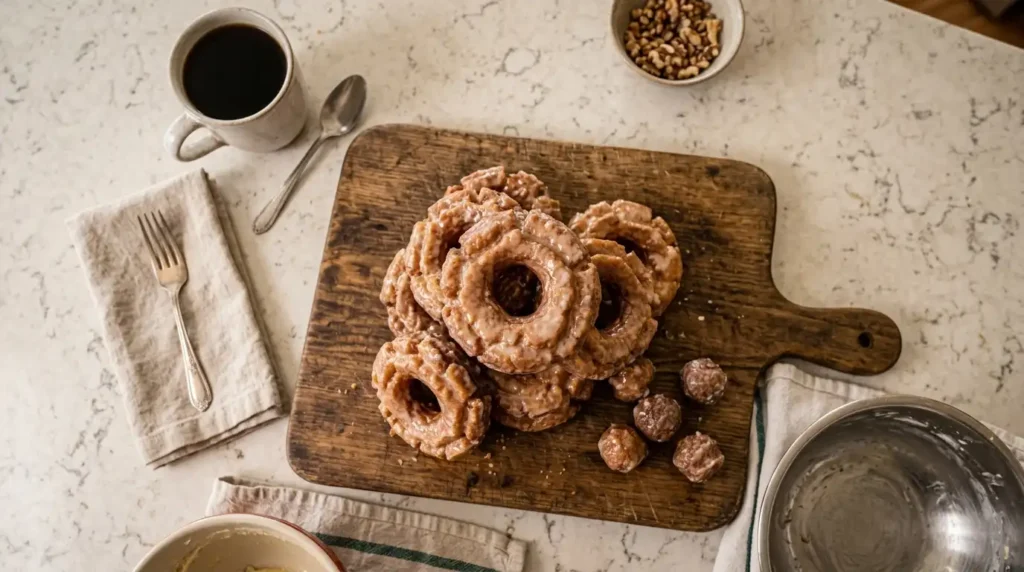
Old Fashioned Donut Recipe
There’s a reason bakery cases save the front row for old fashioned donuts. This old fashioned donut recipe gives you that same craggy, glaze-cracked top and dense, tender crumb, made with pantry staples and no yeast, no proofing, and no waiting around for dough to rise. If you’ve ever wondered how a donut shop gets that rugged, almost volcanic surface on their sour cream donuts, this is the recipe that shows you exactly how, and why it works.
An old fashioned donut is a cake donut leavened with baking powder instead of yeast, made rich with sour cream or buttermilk and a whisper of nutmeg, then fried at a slightly lower temperature so the surface cracks as the inside puffs. No rise time means you can go from mixing bowl to warm, glazed donut in under two hours.
What Is an Old Fashioned Donut, Exactly?
Old fashioned donuts belong to the cake donut family, not the yeast-raised family. That distinction matters because it changes everything about how you mix, rest, and fry the dough. Instead of proofed, stretchy yeast dough, you’re working with a thicker batter-like dough held together by baking powder, eggs, and a tangy dairy ingredient like sour cream or buttermilk.
That tang does double duty. It adds flavor and it reacts with the baking powder to help the donuts puff up fast once they hit hot oil. The result is a donut that’s denser and heartier than a Krispy Kreme-style raised donut, with a crisp, almost cookie-like edge where the glaze pools into every crack.
Historically, “old fashioned” donuts get their name simply because this is closer to how home cooks made fried cakes generations ago, before commercial yeast donuts took over shop counters. No fancy equipment, no donut pan required, just a rolling pin, a cutter, and a pot of oil.
Old Fashioned Donut Recipe Ingredients
You likely have most of this list in your kitchen already.
For the donuts:
- 3 cups cake flour, plus more for dusting
- 2 teaspoons baking powder
- ½ teaspoon salt
- ¼ teaspoon ground nutmeg
- ⅔ cup granulated sugar
- 4 tablespoons unsalted butter, room temperature
- 3 large egg yolks
- 1 cup sour cream (or full-fat buttermilk)
- Neutral oil, for frying
For the glaze:
- 2½ cups powdered sugar
- 5 tablespoons whole milk or water
- ½ teaspoon vanilla extract
- Pinch of salt
A few ingredient notes worth knowing before you start. Cake flour has less protein than all-purpose flour, which is what gives these donuts their tender, almost velvety crumb instead of a chewy one. If you only have all-purpose on hand, you can substitute it, but expect a slightly denser bite. Egg yolks only, not whole eggs, keep the dough rich without adding extra structure that would toughen the donut. And whether you reach for sour cream or buttermilk comes down to preference: sour cream gives a slightly richer, tangier crumb, while buttermilk yields a marginally lighter texture.
How to Make Old Fashioned Donuts, Step by Step
1. Mix the dry and wet separately
Whisk together the cake flour, baking powder, salt, and nutmeg in one bowl. In a stand mixer or large bowl, cream the butter and sugar until light, then beat in the egg yolks one at a time until fluffy.
2. Bring the dough together
Add the sour cream to the butter mixture and mix until combined, then fold in the dry ingredients in two or three additions. Stop as soon as no streaks of flour remain. Overmixing at this stage is the number one reason old fashioned donuts turn out tough instead of tender, so resist the urge to keep beating once it’s combined.
3. Chill the dough
Cover the dough and refrigerate it for at least an hour, up to overnight. This isn’t optional. Chilling firms up the butter so the dough can be rolled and cut cleanly, and it gives the baking powder time to fully hydrate, which helps the donuts puff evenly in the oil.
4. Roll, cut, and rest
On a well-floured surface, roll the chilled dough to about ½-inch thickness. Cut circles with a 3-inch donut cutter, then punch a hole in the center of each with a smaller cutter (or the wide end of a piping tip). Gather scraps gently, re-roll once, and cut again.
5. Fry low and slow
Heat about 2 inches of neutral oil in a heavy pot to 325 to 335°F. This is a touch cooler than most frying, and that’s intentional: a gentler fry gives the exterior time to set while the interior is still expanding, which is exactly what produces the classic cracked top. Fry two or three donuts at a time for about 2 minutes per side, until deep golden brown. Drain on a wire rack.
6. Glaze while warm
Whisk the powdered sugar, milk, vanilla, and salt into a smooth glaze. Dip the craggy top of each donut while it’s still warm, then set glaze-side up on a rack to firm into that signature crackly shell.
Why Do Old Fashioned Donuts Crack on Top?
This is the detail that separates a true old fashioned donut from an ordinary cake donut, and it comes down to simple kitchen chemistry. The dough is leavened with baking powder, which starts releasing gas the moment it hits hot oil. Because the frying temperature is a bit lower than standard, the exterior of the donut sets more slowly, giving the interior extra time to expand before a crust locks it in place. That expanding center has nowhere to go but up and out through the top, the weakest point, which splits the surface into those signature ridges and crags.
It’s the same reason a loaf of quick bread often cracks down the middle as it bakes. More surface area from those cracks also means more glaze clings to every donut, which is half the appeal.
Pro Tips for the Best Old Fashioned Donut Recipe
- Weigh your flour if you can. Scooping flour straight from the bag packs in too much, leading to dry, dense donuts. Spoon it into the measuring cup and level it off instead.
- Don’t skip the thermometer. Oil that’s too cool makes greasy donuts, since they sit in the oil longer and soak up more of it. Oil that’s too hot burns the outside before the inside cooks through. A clip-on candy or fry thermometer takes the guesswork out entirely.
- Give the oil room to breathe. Crowding the pot drops the oil temperature fast, so fry in small batches.
- Glaze at the right moment. Donuts need to be warm, not hot, for the glaze to set into that shiny, crackly finish. Piping hot donuts will melt the glaze right off; fully cooled donuts won’t absorb it well.
- Reroll scraps just once. Dough that’s worked too many times gets tough, so use a cutter size that minimizes leftover scraps in the first place.
Old Fashioned Donut Recipe Variations
Once the base dough and technique are down, this recipe is easy to riff on:
- Chocolate old fashioned: Swap ¼ cup of the cake flour for cocoa powder for a rich, chocolatey version.
- Buttermilk swap: Replace the sour cream with an equal amount of full-fat buttermilk for a slightly tangier, lighter crumb.
- Cinnamon-sugar finish: Skip the glaze and toss warm donuts in a mix of cinnamon and granulated sugar instead.
- Maple or brown butter glaze: Replace the vanilla in the glaze with maple extract, or brown the butter before whisking it into the glaze for a nutty depth.
- Spiced version: Add a pinch of cinnamon, ginger, or allspice alongside the nutmeg for a warmer, autumn-leaning flavor.
Storing, Freezing, and Reheating
Old fashioned donuts are best the day they’re made, but they hold up better than yeast donuts thanks to their denser crumb. Store leftovers in an airtight container at room temperature for up to two days, or in the fridge for up to four. To freeze, cool the donuts completely, wrap each one individually, and freeze in a zip-top bag for up to three months. Thaw overnight in the fridge, then warm briefly in a toaster oven or microwave to bring back that fresh-fried texture before serving.
You can also make the dough up to a day ahead and keep it covered in the fridge, then roll, cut, and fry whenever you’re ready for warm donuts.
What’s the difference between an old fashioned donut and a regular cake donut?
All old fashioned donuts are cake donuts, but not all cake donuts are old fashioned. The old fashioned style specifically has a craggy, cracked surface, a slight tang from sour cream or buttermilk, and a hint of nutmeg, while other cake donuts can be smoother and more neutral in flavor.
Why do old fashioned donuts have cracks on top?
The cracks come from baking powder reacting quickly in hot oil while the exterior sets more slowly at a lower frying temperature. The interior keeps expanding after the outside firms up, so the top splits into ridges as steam escapes.
What oil temperature is best for frying old fashioned donuts?
Aim for 325 to 335°F, which is a little cooler than standard donut frying. That gentler heat is what allows the surface to crack properly instead of setting too fast for the classic texture to form.
Can I use buttermilk instead of sour cream?
Yes. Buttermilk works as a one-to-one swap for sour cream in this old fashioned donut recipe and produces a slightly lighter, tangier donut. Both give the dough the acidity it needs to react with the baking powder.
Can I bake these instead of frying them?
Baking will give you a soft cake, not the crisp, cracked exterior that defines an old fashioned donut. If you want a baked version, look for a recipe built specifically for the oven, since the dough ratios differ.
If you make this old fashioned donut recipe, the biggest payoff comes from patience in two places: letting the dough chill fully and keeping that oil temperature steady. Get those two details right and the rest, cracked tops, crackly glaze, and all, takes care of itself.

Pingback: Wisconsin Old Fashioned Recipe (Sweet, Sour or Press)