
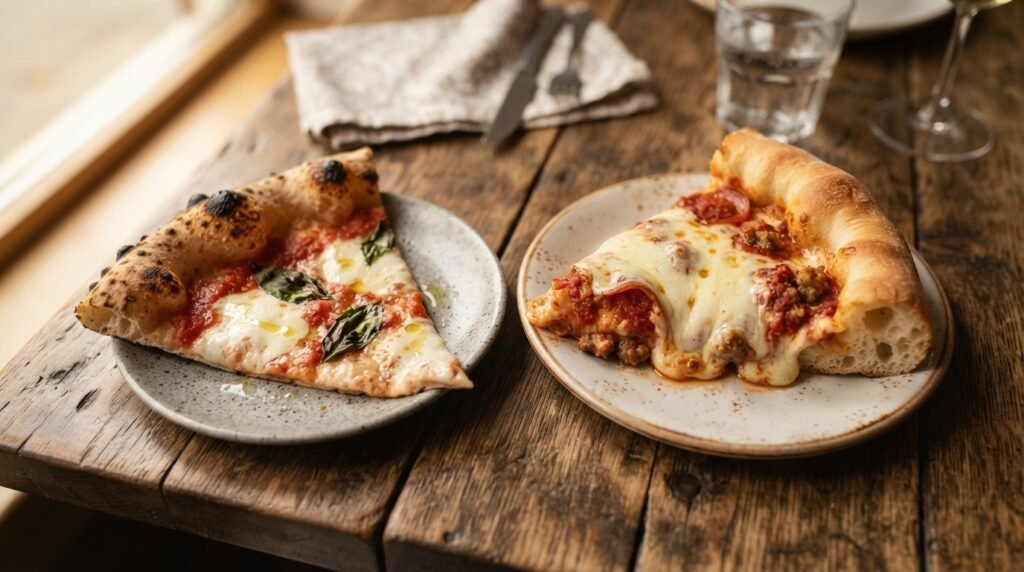
Thick and Thin Pizza: What Actually Makes Them Different
If you have ever stood at a counter arguing with a friend about thick and thin pizza, you already know this debate gets personal fast. The short answer is that the difference comes down to dough thickness, bake time, and how much weight the crust can carry before it turns into a soggy mess in your hand. Everything else, from calories to toppings to which regional style you love, follows from that one starting point.
I have made both styles more times than I can count in my own kitchen, and the crust is never just a base. It decides how a pizza eats, how it travels, and how many slices you can realistically finish before you regret it. This guide breaks down exactly what separates thick and thin pizza, which regional styles fall into each camp, and how to pick the right one depending on what you are actually craving.
Thick and Thin Pizza Crust: The Real Differences

Thin crust runs about a quarter inch thick or less, rolled or stretched out until the dough is taut and even from center to edge. Thick crust starts at roughly half an inch and can go much deeper for pan or deep-dish styles, and it is usually pressed rather than stretched so it holds its shape in the pan.
That thickness gap changes almost everything downstream.
- Texture: Thin crust bakes fast at high heat, so it comes out crisp, sometimes cracker-like, with a light chew. Thick crust bakes longer and slower, which gives it a soft, doughy interior with a chewier bite.
- Topping load: A thin crust cannot support much weight before it goes soggy in the middle, so pizzerias keep toppings light and deliberate. Thick crust is built to carry heavy sauce, extra cheese, and multiple meats without buckling.
- Bake time: Because thin dough is barely there, it fires off in a few minutes in a hot oven. Thick crust needs real time in the oven so the center cooks through without burning the bottom.
- Portion feel: A thin crust pizza slice is light enough that most people go through two or three without feeling stuffed. Thick crust fills you up faster, so fewer slices do the job.
None of this makes one version objectively better. It just means thick and thin pizza are built for different moments, and knowing the mechanics helps you order the one that actually fits what you want tonight.
- Size on the plate: Thin crust pies often stretch out to a larger diameter, which is part of why they feel like the natural choice for sharing. Thick crust holds more per square inch, so a smaller pie can still feed the same number of people.
- Reheating: Thin crust reheats fastest in a hot skillet or oven and crisps back up in a few minutes. Thick crust needs a little longer and benefits from a lower, slower reheat so the center warms without drying out the edges.
How Thick Crust Pizza Is Made

Thick crust dough usually gets a longer rise, which builds more air pockets and a softer crumb once it bakes. Instead of being stretched thin, the dough is pressed into a pan, often with oil coating the bottom and sides, which is what gives deep-dish and pan-style crusts their slightly fried edge. Because the dough is dense and often layered with cheese and toppings underneath the sauce, thick crust pizza takes noticeably longer in the oven so the middle sets fully.
Chicago deep-dish is the most famous example, with a buttery, flaky crust pressed high up the sides of the pan to hold a heavy load of cheese, chunky tomato sauce, and sausage. Sicilian-style, sometimes called sfincione, uses a thick rectangular crust that stays light and airy inside while crisping up on the bottom. Detroit-style is another thick crust favorite, baked in a rectangular steel pan with cheese pushed to the crispy caramelized edges.
How Thin Crust Pizza Is Made

Thin crust dough is rolled or hand-tossed until it stretches nearly edge to edge, then baked at very high temperatures, often 475 to 500 degrees Fahrenheit or hotter in a wood-fired oven. That combination of thin dough and blasting heat is what produces the light, crisp texture thin crust is known for, without much rise or chew.
New York-style is the classic American version, foldable and chewy at the edge but thin enough that grease pools slightly on top. Neapolitan pizza, the style most historians trace back to Naples in the 1800s, keeps the crust thin at the center with a puffy, charred edge from a scorching hot oven, and traditionally the dough is hand-kneaded rather than machine-mixed. St. Louis-style takes thin even further, using a cracker-like dough cut into squares, and California-style pizza runs thin and crispy under nontraditional toppings like goat cheese or artichokes.
Thick vs Thin Pizza Crust: Calories and Nutrition

Thin crust generally comes in lower in calories and carbs simply because there is less dough per slice, roughly 20 to 25 grams of carbs compared to closer to 30 grams for a thick crust slice of similar size. That said, crust thickness is only part of the picture. A thin crust piled with extra cheese, pepperoni, and a heavy hand on the oil can easily outweigh a thick crust topped with vegetables and a light layer of cheese.
The most reliable way to compare thick and thin pizza nutritionally is to hold the toppings constant. Same sauce, same cheese, same amount of meat, different crust. Under those conditions, thin crust wins on calories and carbs almost every time because it is simply carrying less bread. If you are watching portions, thin crust also tends to be easier to stop at two slices, while thick crust fills you up faster on fewer pieces, which can work in your favor if you are trying to eat less overall.
Popular Thick and Thin Pizza Styles Around the US

Different regions built their reputations around one side of the thick and thin pizza divide:
- New York-style (thin): Large, foldable slices with a crisp exterior and chewy interior, sold by the slice in nearly every pizzeria in the city.
- Neapolitan (thin): Soft, slightly charred crust baked in under two minutes in a wood-fired oven, topped simply with San Marzano tomatoes and fresh mozzarella.
- St. Louis-style (thin): Cracker-thin dough cut into squares instead of triangles, often topped with Provel cheese.
- Chicago deep-dish (thick): A buttery, pie-like crust pressed into a deep pan and loaded with cheese, chunky sauce, and toppings baked from the bottom up.
- Detroit-style (thick): Rectangular, focaccia-like crust baked in a steel pan with cheese caramelized right against the edges.
- Sicilian-style (thick): A thick, rectangular crust that stays light and fluffy inside with a crisp base.
Quick Answer: Should You Order Thick or Thin Crust Tonight?

If you want the toppings to be the star of the meal, want to eat a few slices without feeling weighed down, or you are ordering for a party where people will be standing and mingling, go thin. If you want a heartier, fork-and-knife meal, are feeding people with big appetites, or you love a pizza loaded with toppings and extra cheese, go thick. There is no wrong answer here since it comes down to the eating experience you are after that night.
Thick and Thin Pizza FAQs
Is thick or thin crust pizza healthier?
Neither is automatically healthier. Thin crust usually has fewer calories and carbs per slice because it uses less dough, but the real difference comes from toppings and portion size, not crust thickness alone.
What is the healthiest way to order pizza?
Choose a thin crust with vegetable toppings and a moderate amount of cheese, and keep an eye on portion size. Two or three slices of a lighter thin crust pizza is generally a more balanced meal than a few slices of a heavily loaded thick crust.
Why does thin crust taste so different from thick crust?
Thin crust bakes fast at high heat, which concentrates flavor into a crisp, slightly charred exterior and lets the toppings dominate. Thick crust has more time in the oven, which develops a softer, breadier flavor that carries the crust itself as part of the taste, not just the toppings.
Is Neapolitan pizza thick or thin crust?
Neapolitan pizza is thin crust, traditionally stretched by hand to no more than about a third of a centimeter thick at the center, with a slightly puffier, charred edge from the intense heat of a wood-fired oven.
How to Choose Between Thick and Thin Pizza for Your Next Order
Think about the meal you actually want. Grabbing a quick slice on the go, feeding a crowd that will be up and moving, or wanting the toppings to shine all point toward thin crust. Sitting down to a filling dinner, craving something you eat with a fork, or wanting a pizza that can carry a heavy topping list all point toward thick crust. Neither style is the “correct” pizza. Thick and thin pizza both earned their popularity for good reason, and the best move is to keep both in rotation depending on what kind of night you are having.
Next time you are debating with the same friend at the counter, skip the argument. Order one of each, split it down the middle, and let the crust speak for itself.

Pingback: Best Pizza in Austin: 15 Spots Worth the Drive (2026)
Pingback: Calories in a Slice of Pizza: The Real Numbers (2026)