
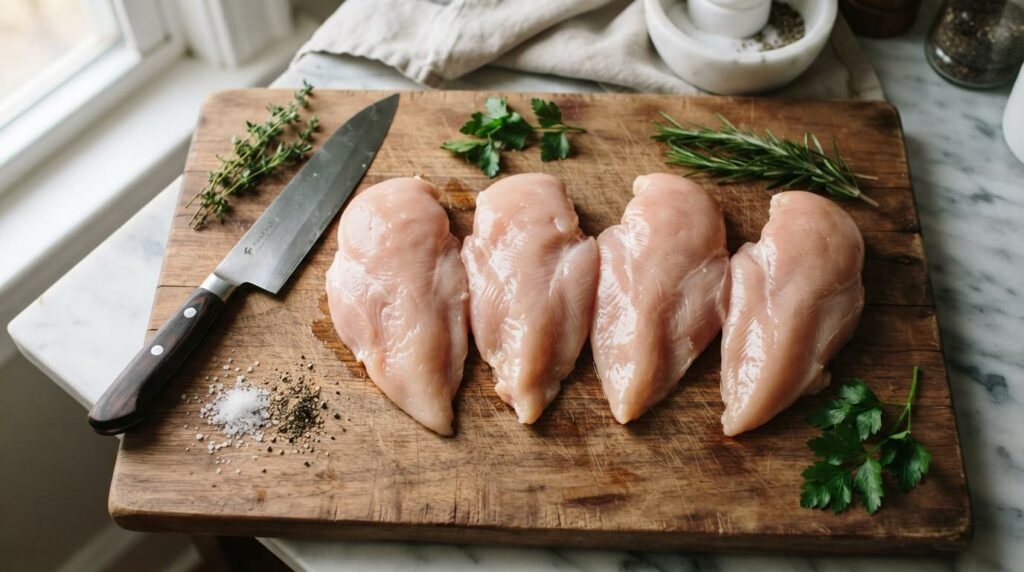
Air-Chilled Chicken Breast: What It Is and the Best Brands to Buy
Air chilled chicken breast is chicken that’s been cooled with cold, circulating air instead of an ice-water bath, which means it never soaks up extra water during processing. If you’ve stood in the meat aisle wondering why one package of boneless skinless breasts costs a couple dollars more per pound than the one next to it, this is usually why. I’ve cooked both side by side in my own kitchen more times than I can count, and the difference shows up the moment the pan hits the stove.
What Is Air-Chilled Chicken Breast?
Air-chilled chicken breast comes from birds that were cooled individually in temperature-controlled chambers filled with purified cold air, rather than being dunked in a shared vat of chlorinated ice water. The process takes a few hours longer than conventional water chilling, but the chicken doesn’t absorb outside moisture, so what you buy is closer to pure meat instead of meat plus retained water.
That one processing choice affects almost everything downstream: how the chicken tastes, how it browns, how fast it cooks, and even how much you’re really paying per pound of actual chicken.
Air-Chilled vs. Water-Chilled Chicken Breast: What’s the Real Difference
Most chicken sold in the United States is still water-chilled. After slaughter, birds are submerged together in a large tank of cold, chlorinated water to bring their internal temperature down to food-safe levels quickly. It’s fast and cheap, but the carcass acts a bit like a sponge. Research on the two methods has found that water-chilled carcasses can gain around 5 percent of their weight from absorbed water, while air-chilled carcasses actually lose a small amount of weight during the process. That absorbed water doesn’t stay put either. Some of it purges out in the package, and the rest evaporates as steam once the chicken hits a hot pan, which is part of why water-chilled breasts can turn out drier and blander.
Air chilling skips the shared bath entirely. Birds move through refrigerated chambers where cold air, not water, does the cooling. Because there’s no submersion, there’s far less opportunity for bacteria from one bird to spread to another, and no diluted flavor from absorbed liquid. The trade-off is time and cost: air chilling takes longer and requires more space and equipment, which is reflected in the price tag at checkout.
There’s also a practical kitchen difference worth knowing. Test kitchens that compared brining air-chilled and water-chilled boneless breasts found the air-chilled chicken absorbed several times more brine in the same amount of time, and the cooked meat retained noticeably more moisture as a result. Water-chilled chicken, already carrying extra water, simply has less capacity to soak up seasoning.
Is Air-Chilled Chicken Breast Worth the Extra Cost?
This is the question that actually decides what goes in your cart, so let’s break it down plainly. Air-chilled chicken breast typically runs a few dollars more per pound than conventional chicken. Here’s what that premium tends to buy you.
More actual chicken per pound. Since water-chilled chicken can carry up to around 8 percent added water by weight, part of what you’re paying for with conventional chicken is water, not meat. With air-chilled chicken, the pound on the scale is essentially all chicken.
Better browning and crispier skin. Without excess surface moisture, air-chilled breasts sear and roast instead of steaming in their own juices, which matters if you’re pan-searing, grilling, or trying to get crackly skin on bone-in cuts.
Faster, more even cooking. Air-chilled chicken tends to cook a little quicker than water-chilled chicken of the same size, since there’s no extra water inside the meat that needs to evaporate before it can properly brown.
More natural flavor. Because nothing has diluted the muscle tissue, the chicken flavor itself is more concentrated, which home cooks and professional chefs alike tend to notice most in simply prepared dishes like roast chicken or grilled breasts.
To be fair, chilling method isn’t the only thing that determines quality. How a specific brand’s birds are raised, fed, and handled between the farm and your fridge matters just as much, and even air-chilled chicken can taste off if it’s been sitting too long in distribution or stored at the wrong temperature. Chilling method is one strong signal of quality, not the whole story.
The Best Air-Chilled Chicken Breast Brands to Buy in 2026
Not every air-chilled brand is processed and raised the same way. These are the names that show up most consistently in U.S. grocery stores, along with what sets each one apart.
Bell & Evans. Widely considered one of the gold standards in U.S. air-chilled chicken, Bell & Evans ships nationally from a single Pennsylvania facility and offers both conventional and USDA-certified organic air-chilled breasts. Cook’s Illustrated has rated their chicken among the best in blind taste tests.
Mary’s Chicken. A family-run California and Utah operation that air-chills both its organic and conventional lines. Mary’s hatches its own chicks rather than sourcing them overseas, and the brand is known for relatively strong transparency about its farming practices.
Smart Chicken. One of the original U.S. air-chilled brands, founded in Nebraska in 1998 specifically to bring the European air-chilling method stateside. It’s now part of Tyson Foods but still processes its chicken using the air-chilled method under the Smart Chicken label.
Springer Mountain Farms. A Georgia-based, family-owned brand that air-chills its fresh, antibiotic-free chicken and is popular across the Southeast.
Trader Joe’s organic chicken. Trader Joe’s organic breasts are air-chilled, and the price point is hard to beat for the category, though the retailer doesn’t disclose which farms it sources from.
Whole Foods 365 and Whole Foods Market brand. Whole Foods carries air-chilled chicken year-round in its meat department, with the “air-chilled” label printed clearly on the package.
Just Bare. A budget-friendlier organic, air-chilled option found in many mainstream grocery stores and online.
If a package doesn’t say “air-chilled” anywhere on the label, front or back, assume it was water-chilled. It’s not always obvious from the color or packaging alone, so the label is genuinely the fastest way to check.
Where to Buy Air-Chilled Chicken Breast Near You
Air-chilled chicken breast has moved well past specialty stores and into most mainstream grocery chains. You’ll typically find it at Whole Foods Market, Sprouts Farmers Market, Central Market, and Kroger-owned stores, usually under a Simple Truth or Private Selection label alongside the national brands. Walmart and Target both carry select air-chilled options in their fresh meat cases, and Instacart makes it easy to filter grocery delivery searches specifically for “air-chilled chicken” if your local store’s app doesn’t sort by processing method. Brand websites for Bell & Evans and Mary’s also have store locators, which is the quickest way to confirm a specific option is in stock near you before you make the trip.
How to Cook Air-Chilled Chicken Breast So It Stays Juicy
Because air-chilled chicken breast starts out with less internal moisture than the water-chilled kind, it rewards a slightly different approach at the stove.
Pat it completely dry with paper towels before cooking. This step matters more here than with conventional chicken, since a dry surface is what gives you that deep sear or crispy skin the air-chilling process sets you up for.
Let it come to room temperature for about 20 to 30 minutes before cooking so it cooks through more evenly, rather than going straight from the fridge to a hot pan.
Watch your cook time closely. Air-chilled breasts often cook a few minutes faster than you’d expect, so pull them at 160°F and let carryover heat and a five-minute rest bring them the rest of the way to a safe 165°F, rather than cooking straight through to temperature on the heat.
Season boldly, including with a quick 30 to 45 minute salt brine if you have time. Because air-chilled chicken absorbs brine and marinades far more readily than water-chilled chicken, even a short soak makes a noticeable difference.
Choose high, direct heat methods when you want crispy results. Pan-searing, grilling, and roasting at 425°F all take advantage of the lack of surface moisture, while slow, low methods work fine too but won’t show off the texture as dramatically.
The Bottom Line
Air-chilled chicken breast costs more per pound at the register, but a meaningful chunk of that price difference is simply the water you’re not paying for. Between the better browning, the more concentrated flavor, and the faster, more even cooking, it’s a swap that shows up on the plate almost every time you cook it. Next time you’re at the store, flip the package over, look for “air-chilled” on the label, and give one of the brands above a try in your next weeknight dinner.
Air-Chilled Chicken Breast FAQs
Is air-chilled chicken healthier than water-chilled chicken?
Air-chilled and water-chilled chicken are both considered safe under USDA inspection, and research on the two methods is mixed on bacteria counts, with some studies favoring each side. The clearer difference is nutritional value per dollar: since air-chilled chicken hasn’t absorbed added water, you’re getting more actual protein per pound rather than diluted meat.
Why is air-chilled chicken more expensive?
Air chilling takes several hours longer than water chilling and requires more refrigerated chamber space and handling per bird, which raises processing costs. You’re also not paying for retained water weight, so more of that higher price tag reflects actual chicken.
Does air-chilled chicken taste different from regular chicken?
Yes, most people notice a more concentrated, less watery chicken flavor, along with a firmer, less spongy texture straight out of the package. The difference is usually most obvious in simply seasoned preparations like a roast breast or grilled chicken, where there’s nothing else masking the flavor.
How can you tell if chicken is air-chilled at the store?
Check the front or back of the package for the words “air-chilled” printed directly on the label. If it’s not mentioned anywhere, the chicken was very likely processed using the standard water-chilling method, since air-chilled brands consistently highlight it as a selling point.


Pingback: What Is Halal Chicken? A Complete Guide for Home Cooks