Steelhead Trout vs Salmon: What’s the Real Difference?
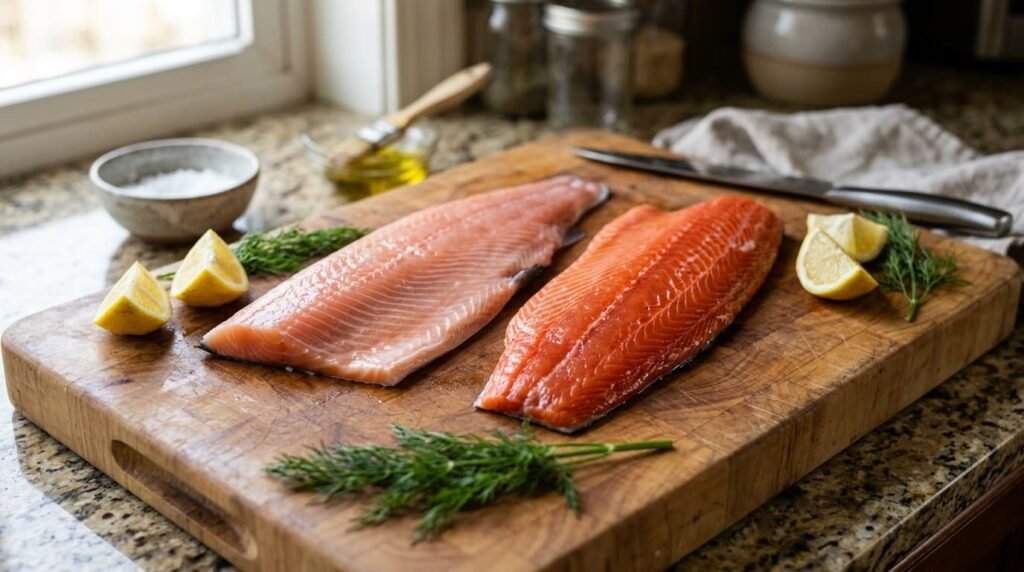
If you have ever stood at a seafood counter looking at two nearly identical pink fillets, you have probably wondered about steelhead trout vs salmon. They can look alike, cook in similar ways, and even appear in recipes with the same sauces. But they are not the same fish.
The biggest difference starts with biology: steelhead is the ocean-going form of rainbow trout, while salmon refers to several different species of fish. That distinction affects everything from flavor and fat content to texture, price, and the way each fish behaves during cooking.
There is also an important catch: “salmon” is not a single product. King salmon can be dramatically richer than Sockeye, while farmed Atlantic salmon has a different texture and fat profile again. So comparing steelhead with “salmon” without considering the salmon species can be misleading.
For most home cooks, the practical question is simpler: Which one should I buy, and can I use steelhead when a recipe calls for salmon?
Usually, yes. But knowing where the two differ helps you get better results.
Is Steelhead Trout Actually Salmon?
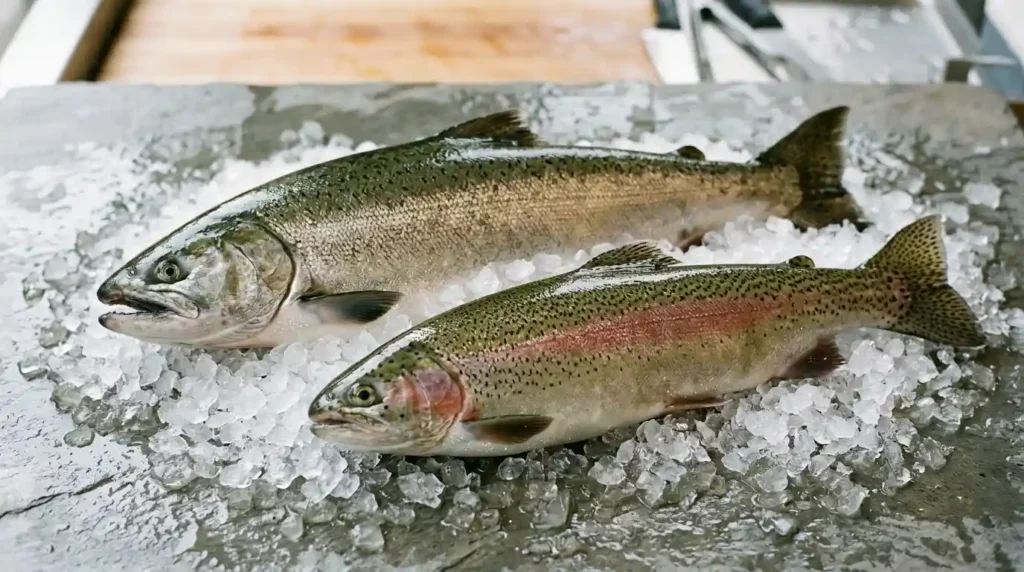
No. Steelhead trout is not a salmon species.
Steelhead is Oncorhynchus mykiss, the same species as rainbow trout. The difference is its life history. A typical rainbow trout spends its life in freshwater, while steelhead migrate from freshwater into the ocean or, in some populations, a large lake before returning to freshwater to reproduce.
Both steelhead and salmon belong to the Salmonidae family, which explains why they have several similarities. Their flesh can have a similar pink-to-orange appearance, both can be prepared using many of the same cooking methods, and both have an oily-fish flavor without being extremely strong.
The confusion becomes even greater because steelhead is sometimes casually marketed as “steelhead salmon.” That name can make it sound like a salmon species, but technically it is still rainbow trout.
There is another biological difference worth knowing. Many Pacific salmon species are semelparous, meaning they generally spawn once and die afterward. Steelhead can survive spawning and return to spawn again, although survival and repeat spawning vary by population and conditions.
For the shopper, however, the species label matters more than the terminology. If you want to know exactly what is on your plate, look for the scientific or common species name rather than relying only on a marketing description.
How Are Steelhead Trout and Salmon Different?
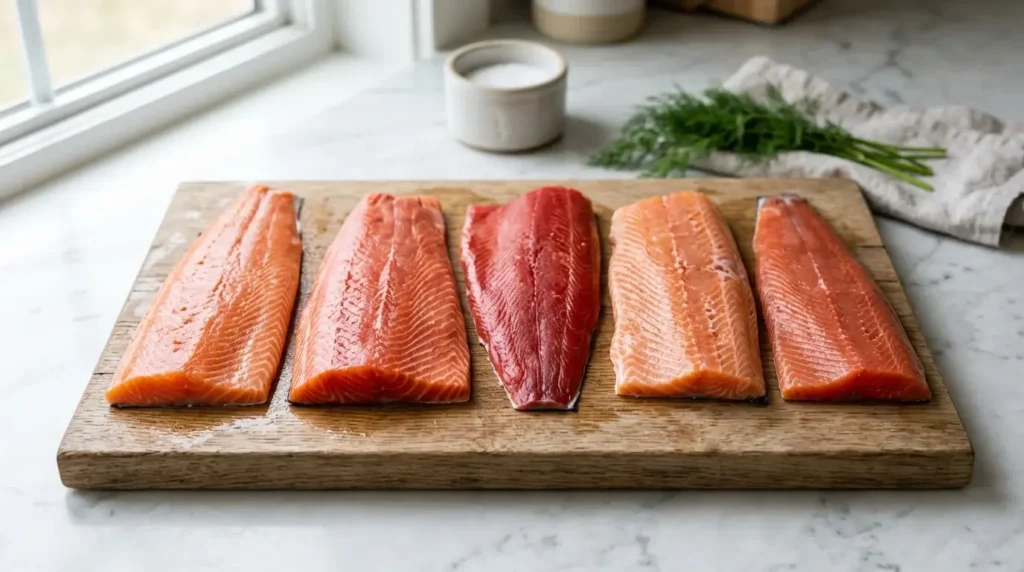
The easiest way to understand steelhead trout vs salmon is to separate the comparison into four areas: species, flavor, nutrition, and cooking behavior.
| Feature | Steelhead Trout | Salmon |
|---|---|---|
| What it is | Sea-run rainbow trout | Several different fish species |
| Scientific name | Oncorhynchus mykiss | Depends on species |
| Flavor | Mild, delicate, slightly sweet | Mild to rich, depending on species |
| Texture | Tender and flaky | Usually tender, often richer and firmer |
| Fat | Generally moderate | Varies widely; some species are very fatty |
| Flesh color | Pink to orange | Pink to deep red-orange |
| Typical cooking use | Baking, grilling, roasting, poaching | Baking, grilling, roasting, broiling, smoking |
| Price | Often competitively priced | Can range from budget-friendly to premium |
| Best known advantage | Mild flavor and easy substitution | Wide range of flavors and richness |
That table is useful, but it hides one major issue: salmon varies enormously.
A fatty King salmon is not a fair one-to-one comparison with a leaner steelhead fillet. Likewise, comparing steelhead with inexpensive canned Pink salmon produces a very different result.
When someone says, “Salmon tastes richer,” the statement may be true for one type and less noticeable with another.
What Does Steelhead Trout Taste Like Compared With Salmon?
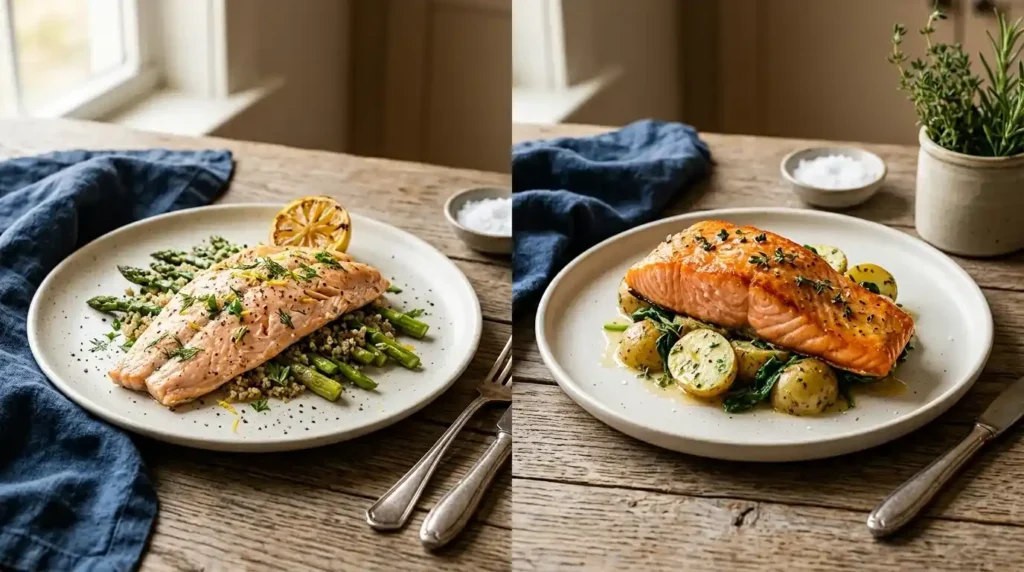
Steelhead generally has a milder, cleaner flavor than many salmon varieties. It can have a subtle sweetness and a delicate richness without the heavier oily character associated with some fatty salmon.
That makes steelhead particularly useful when you want the appearance and versatility of salmon but prefer a less pronounced seafood flavor.
Salmon can range from relatively mild to intensely rich. King salmon, for example, is known for its high fat content and buttery texture. Sockeye usually has a deeper, more distinctive flavor and firmer flesh. Farmed Atlantic salmon tends to be milder and consistently fatty.
Texture matters just as much as taste.
Steelhead has tender flesh that flakes easily when properly cooked. Because it is often less fatty than richer salmon, it has a smaller margin for overcooking. Leave it in the oven a little too long and the difference becomes noticeable.
Salmon’s additional fat can make some varieties more forgiving. That does not mean salmon cannot become dry—it certainly can—but a fatty fillet generally has more natural moisture and richness to work with.
Which One Is Better for People Who Dislike Strong Fish Flavor?
Steelhead is often the more comfortable starting point.
A useful example is a simple dinner with lemon, garlic, olive oil, and herbs. With steelhead, those ingredients can remain prominent because the fish has a relatively delicate flavor. With a rich salmon fillet, the fish itself becomes a stronger part of the overall dish.
This is not a strict rule. Freshness, species, farming method, storage, and cooking all affect flavor. But if your main concern is avoiding an assertive fish taste, steelhead is worth considering.
Steelhead Trout vs Salmon: Which Is More Nutritious?
Both are nutrient-dense fish and good sources of high-quality protein, omega-3 fatty acids, vitamins, and minerals.
The important point is that there is no single nutrition profile for “salmon.” Different species and farming methods can produce meaningful differences in fat and calorie content.
Steelhead can be a little leaner than particularly fatty salmon varieties. That may make it attractive when you want a lighter meal while still getting substantial protein and beneficial fats.
Salmon, especially fatty varieties, generally provides plenty of long-chain omega-3 fatty acids. Steelhead also provides omega-3s, so choosing it does not mean giving up the nutritional advantages associated with eating oily fish.
Instead of asking which fish is universally “healthier,” it makes more sense to ask what you want from the meal.
If you want:
- A lighter, less fatty fillet, steelhead may fit better.
- A richer source of dietary fat, a fatty salmon variety may be preferable.
- High-quality protein, both are strong options.
- More predictable richness, farmed Atlantic salmon can be consistent.
- A milder fish flavor, steelhead may be easier to enjoy.
Preparation also matters. A simple roasted fillet with vegetables is a different nutritional proposition from a fish dish covered in a heavy cream sauce or deep-fried coating.
Does Steelhead Have More or Less Fat Than Salmon?
It depends on the salmon.
That is one of the most important details often missing from basic comparisons. Steelhead is generally less fatty than very rich salmon varieties, but salmon ranges from relatively moderate to quite high in fat.
For a practical comparison, check the nutrition label for the exact fish you are buying rather than relying on a general “salmon” number.
This matters especially if you are tracking calories, total fat, or omega-3 intake. Species, farmed versus wild fish, serving size, and preparation can all change the final numbers.
Which Fish Is Easier to Cook?
Both are easy to cook, but steelhead requires a little more attention to timing when the fillet is relatively lean.
A salmon fillet with plenty of fat can tolerate a little extra heat without becoming dry immediately. Steelhead can move from moist and tender to dry more quickly.
That makes the Home cooks method important.
Baking Steelhead or Salmon
For either fish, baking is one of the simplest approaches.
Place the fillet skin-side down on a lightly oiled baking sheet or dish, season it, and cook until it reaches your preferred level of doneness. Thickness matters more than a fixed number of minutes, so avoid relying blindly on a recipe’s cooking time.
For steelhead, start checking earlier if the fillet is thin.
A practical mistake to avoid is assuming that a thick center and thin tail section will finish at exactly the same time. The tail can become dry while the center is still cooking. If the fillet is uneven, tuck the thin end under slightly or choose pieces with a more consistent thickness.
Grilling Steelhead vs Salmon
Salmon’s higher-fat varieties are particularly convenient on a grill, but steelhead works well too.
The main challenge is preventing sticking and overcooking.
Oil the grates properly, dry the fish before seasoning, and avoid constantly moving the fillet. If the fish is delicate or you are worried about losing it through the grates, a grill basket or foil can make the process easier.
Steelhead benefits from close attention because its lower fat content gives you less room for error.
Poaching and Foil-Baked Fish
These methods are especially useful when moisture retention is the priority.
Wrapping steelhead with lemon, herbs, garlic, and a small amount of oil creates a humid cooking environment that helps protect the flesh from drying out.
The same approach works for salmon, although a rich salmon fillet may not need as much help staying moist.
Can You Substitute Steelhead Trout for Salmon?
Yes. In most cooked recipes, steelhead can replace salmon without changing the entire recipe.
This works particularly well in:
- Baked fish recipes
- Foil packets
- Grain bowls
- Salads
- Fish tacos
- Pasta dishes
- Rice bowls
- Grilled fish recipes
- Simple herb-and-lemon preparations
The main adjustment is cooking time.
If the original recipe was developed for a thick, fatty salmon fillet, do not automatically give a leaner steelhead fillet the exact same amount of time. Start checking it earlier and use the fish’s appearance and internal temperature as guides.
A good substitution is not just about replacing one ingredient with another. You also need to account for what changes.
For example, a salmon recipe built around the fish’s rich fat may taste lighter when made with steelhead. You may want a little extra olive oil, butter, or sauce to provide the richness the salmon would have contributed naturally.
On the other hand, that lighter profile can be exactly what you want in a citrus-heavy or herb-forward dish.
How Do Steelhead and Salmon Compare in Price?
Price varies by region, season, species, farming method, and retailer, so there is no reliable universal price difference.
Steelhead is often competitively priced, particularly when sold as a farmed product. Salmon, meanwhile, covers a huge price range.
At one end, some salmon products are relatively affordable. At the other, premium wild King or Sockeye can cost substantially more.
Rather than deciding based only on the name, compare the actual products in front of you.
Look at:
- Species — King, Sockeye, Coho, Atlantic, or steelhead.
- Wild or farmed — This can affect both price and flavor.
- Fillet thickness — Thicker cuts may be easier to cook evenly.
- Freshness — A cheaper fish is not a bargain if it has been poorly handled.
- Skin-on or skinless — Skin-on fillets can be useful for pan-searing.
- Portion size — Compare price per pound rather than package price alone.
A common shopping mistake is choosing based on the lowest sticker price without checking what type of salmon it is. A lower-priced salmon variety and a higher-priced premium variety are not necessarily comparable products.
Is Steelhead More Sustainable Than Salmon?
There is no simple “steelhead wins” or “salmon wins” answer.
Sustainability depends on the specific fishery or farm, production method, location, management practices, and current certification or assessment.
Wild salmon from a well-managed fishery can be a responsible choice. Farmed seafood can also have advantages, but environmental impacts vary considerably between production systems.
The same principle applies to steelhead.
Instead of treating the species name as a sustainability guarantee, check the information attached to the product. Depending on where you shop, you may see details about:
- Wild-caught or farm-raised production
- Country or region of origin
- Fishery management
- Aquaculture method
- Sustainability certification
- Seafood sustainability ratings
This approach is more useful than assuming every steelhead or every salmon product has the same environmental footprint.
What About Mercury and Food Safety?
Both salmon and trout are generally considered lower-mercury seafood choices compared with many large predatory fish.
However, food safety is not just about mercury.
Storage, handling, cooking, and sourcing matter too. Keep fresh fish properly refrigerated, follow package instructions for previously frozen products, and cook according to appropriate food-safety guidance.
Raw preparations require additional care. A fish being labeled “fresh” does not automatically mean it is appropriate for raw consumption. If you are preparing sushi, sashimi, or crudo at home, use fish specifically sourced and handled for that purpose and follow reliable food-safety guidance.
This is another place where copying a recipe’s instructions without considering the actual product can cause problems.
Can You Use Steelhead for Sushi or Raw Recipes?
Steelhead can appear in raw preparations, but the key issue is safe sourcing and handling, not simply whether the fish is steelhead or salmon.
Salmon is far more familiar in sushi restaurants, but familiarity does not make every salmon fillet suitable for eating raw. Likewise, an ordinary supermarket steelhead fillet should not automatically be treated as sushi-ready.
For cooked dishes, this distinction is much less complicated. Both fish are versatile and work beautifully with simple preparations.
Common Mistakes When Choosing Between Steelhead and Salmon
The most common mistake is treating salmon as one uniform fish.
It is not.
Comparing steelhead with King salmon is different from comparing it with farmed Atlantic salmon or Pink salmon. If you want to make a useful comparison, identify the salmon species first.
Another mistake is judging quality by color alone. Bright orange or deep red flesh can be attractive, but flesh color is affected by species, diet, and other factors. Color by itself does not tell you everything about freshness or quality.
A third mistake is cooking both fish for exactly the same amount of time.
A thick salmon fillet and a thin steelhead fillet can require very different cooking times even when they weigh roughly the same.
Finally, do not assume the more expensive fish will automatically taste better to you. If you prefer mild, delicate seafood, the richer character of a premium salmon may actually be less appealing.
Which Fish Should You Buy?
The answer depends on the meal you are planning.
Choose steelhead trout if you want:
- A mild, slightly sweet seafood flavor
- A tender, flaky fillet
- A potentially lighter alternative to rich salmon
- A versatile fish for weeknight meals
- A salmon-like fish without quite as much richness
Choose salmon if you want:
- A wider range of flavor and texture options
- A richer, more buttery fillet
- A particularly fatty fish such as King salmon
- A stronger flavor that can stand up to bold sauces or smoke
- A familiar choice for classic salmon recipes
For a simple weeknight dinner, I would first think about the flavor and thickness of the actual fillet in front of me, not just the fish’s name.
If the steelhead looks fresh and the salmon is a very fatty variety, expect a noticeably different meal. If the comparison is between steelhead and mild farmed Atlantic salmon, the gap may be much smaller.
That is the useful way to think about steelhead trout vs salmon: not as a competition between two identical products, but as two closely related options with different characteristics.
Is steelhead trout the same as salmon?
No. Steelhead is the migratory form of rainbow trout, scientifically known as Oncorhynchus mykiss. Salmon refers to multiple species within the Salmonidae family.
Does steelhead taste like salmon?
Yes, but it is generally milder and somewhat less rich than many salmon varieties. The exact difference depends on the salmon species being compared.
Which tastes less fishy, steelhead or salmon?
Steelhead is often the milder choice. However, freshness and cooking technique have a major effect on how fish tastes.
Is steelhead healthier than salmon?
Neither is automatically healthier in every situation. Both provide protein and beneficial nutrients. Steelhead may be leaner than fatty salmon varieties, while fatty salmon can provide more omega-3 fat.
Can you cook steelhead the same way as salmon?
For most cooked recipes, yes. Baking, grilling, roasting, poaching, and foil cooking all work well. Just watch the cooking time because a leaner steelhead fillet can dry out faster.
Why does steelhead look so much like salmon?
Both belong to the Salmonidae family and can develop pink or orange flesh. Steelhead also has a body shape and life cycle that resemble those of salmon, which makes the two easy to confuse at the seafood counter.
Which is better for a simple weeknight dinner?
If you want a mild, easy-to-pair fish, steelhead is a practical option. If you want a richer and more buttery result, a fatty salmon variety may be more suitable.
Can you substitute steelhead for salmon?
Yes. Steelhead works in most cooked salmon recipes. Start checking for doneness a little earlier, especially when using a thin or lean fillet.