Jasmine Rice to Water Ratio: Get Fluffy Rice Every Time
Getting the jasmine rice to water ratio right is the easiest way to avoid rice that is either crunchy, soggy, or stuck together in one big clump. For most white jasmine rice cooked on the stovetop, a good starting point is 1 cup jasmine rice to 1 1/4 cups water. If you rinse the rice well and use a tight-fitting lid, you may find that slightly less water works even better.
The exact amount isn’t universal, though. Your cooking method, the age of the rice, how thoroughly you rinse it, the type of pot you use, and even how tightly the lid fits can change the result.
I’ve found that the biggest mistake people make is treating every type of white rice the same. Jasmine rice cooks differently from some other long-grain varieties, so simply following a generic 1:2 rice-to-water ratio can leave you with much softer rice than you wanted.
Here’s how to choose the right ratio and adjust it when your rice doesn’t come out perfectly.
What Is the Best Jasmine Rice to Water Ratio?
For white jasmine rice, these ratios are useful starting points:
| Cooking method | Jasmine rice | Water |
|---|---|---|
| Stovetop, rinsed | 1 cup | 1 1/4 cups |
| Stovetop, well-rinsed | 1 cup | About 1 1/4 cups, adjusted to preference |
| Rice cooker | 1 cup | About 1 1/4 cups* |
| Instant Pot | 1 cup | 1 cup |
| Microwave | 1 cup | About 1 1/2 cups |
*Rice cookers vary, so the manufacturer’s measuring cup and water markings may give different instructions.
The 1:1.25 ratio is a practical stovetop starting point for white jasmine rice. However, don’t assume you have to use exactly the same amount every time. If your rice is consistently too soft, reduce the water slightly. If it remains firm after cooking and resting, add a little more next time.
One useful approach is to change the water by 1 to 2 tablespoons at a time rather than making a large adjustment.
Also, make sure you’re working with white jasmine rice. Brown jasmine rice requires more water and a much longer cooking time because the bran layer remains intact.
Why Jasmine Rice Needs Less Water Than You Might Expect
One common assumption is that all rice needs roughly twice as much water as rice. That’s not how it works.
Rice absorbs water while it cooks, but some water also escapes as steam. The amount needed depends on the variety of rice and the cooking method.
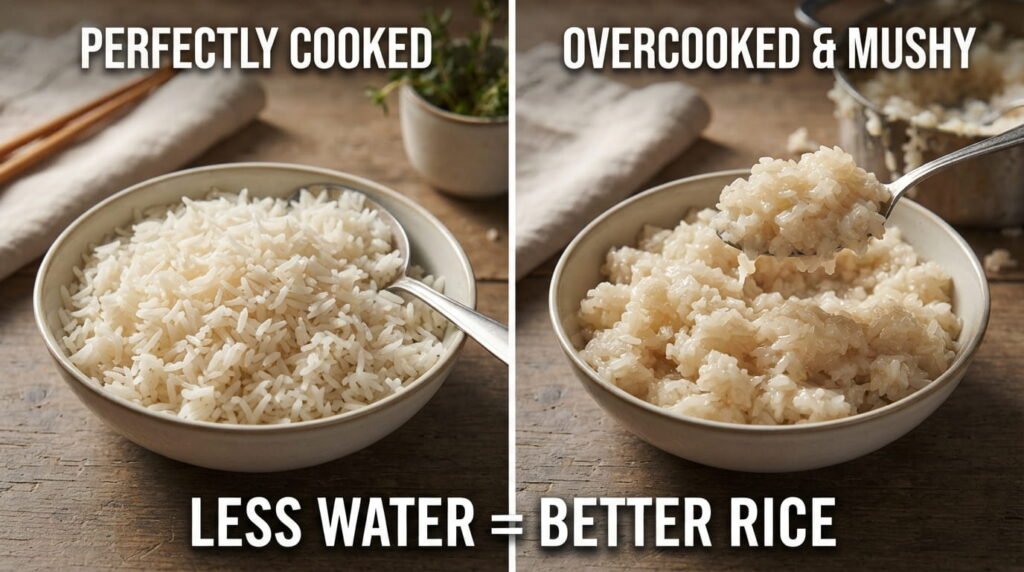
Jasmine rice has a naturally soft, slightly sticky texture when cooked properly. It also has a distinctive floral aroma and tender grains. Adding excessive water can push that texture too far, turning the rice wet and mushy rather than tender and fluffy.
That’s why a generic 1 cup rice to 2 cups water approach may not give you the result you’re looking for.
There’s another factor people often overlook: the cooking vessel matters. A wide saucepan can lose water faster through evaporation than a smaller saucepan with a tight lid. If you change pots but keep everything else identical, the same ratio can produce a different result.
So think of the ratio as your starting point, not an unchangeable rule.
How to Cook Jasmine Rice on the Stovetop
The stovetop gives you the most control, and once you’ve found the right ratio for your particular rice and pot, it is very repeatable.
1. Rinse the rice
Measure 1 cup of jasmine rice and place it in a fine-mesh strainer or bowl.
Rinse it under cool water, gently moving the grains around, until the water becomes less cloudy. You don’t necessarily need perfectly clear water. The goal is mainly to remove excess surface starch.
Drain the rice well.
This step is worth doing because excess starch can make the finished rice noticeably stickier. If you’re making fried rice later, rinsing and cooking the grains properly is particularly helpful because you generally want separate grains.
2. Add the rice and water
Put the drained rice into a saucepan with 1 1/4 cups water.
Add a small pinch of salt if you like.
For your first batch, resist the temptation to add extra water “just in case.” Extra water is difficult to remove once it has been absorbed.
3. Bring it to a boil
Place the saucepan over medium-high heat and bring the water to a boil.
Once it reaches a boil, immediately reduce the heat to low and cover the saucepan with a tight-fitting lid.
4. Simmer without stirring
Let the rice cook gently for approximately 12 to 15 minutes, depending on your stove, pot, and rice.
Don’t keep opening the lid to check it.
Every time you lift the lid, steam escapes. That steam is part of the cooking environment, so repeatedly checking the rice can interfere with the cooking process.
You also don’t need to stir jasmine rice while it cooks. Stirring can disturb the grains and release more surface starch.
5. Let the rice rest
When the cooking time is finished, turn off the heat and leave the saucepan covered for about 10 minutes.
This step is easy to skip, but it can make a noticeable difference.
The rice continues to settle and absorb remaining moisture while it rests. If you immediately remove the lid and serve it, the texture can be less even.
After resting, remove the lid and gently fluff the rice with a fork.
Don’t mash or aggressively stir it. Lift and separate the grains.
Does Rinsing Change the Jasmine Rice to Water Ratio?
Yes, rinsing can affect how much water you prefer to use, but it doesn’t mean you need to make a dramatic change.
A well-rinsed batch may cook slightly differently from unrinsed rice because the grains have been exposed to water before cooking and excess surface starch has been removed.
For that reason, some cooks prefer using slightly less water after rinsing. Rather than treating this as a strict formula, use your first batch as a test.
For example:
- Rice too soft: reduce the water by 1 to 2 tablespoons next time.
- Rice too firm: increase the water by 1 to 2 tablespoons.
- Rice sticky but fully cooked: rinse more thoroughly and avoid stirring during cooking.
- Rice wet at the bottom: check your heat level and resting time before changing the ratio dramatically.
The goal isn’t simply to make rice that is dry and separate. Proper jasmine rice should still be tender and pleasantly moist.
Jasmine Rice Ratio for a Rice Cooker
A rice cooker makes the process easier because it controls the cooking temperature and automatically switches modes when the cooking cycle is finished.
As a starting point, use approximately 1 cup jasmine rice to 1 1/4 cups water if you’re measuring water separately.
However, rice cookers are one place where you should pay attention to the manufacturer’s instructions.
Many rice cookers include a small measuring cup and corresponding water lines inside the cooking bowl. That cup may not equal a standard U.S. measuring cup, so mixing the manufacturer’s cup with standard cup measurements can lead to confusion.
For consistent results:
- Measure the rice using the same cup every time.
- Rinse the rice if you prefer a less starchy result.
- Add the recommended water.
- Start the white-rice cycle.
- Let the cooked rice sit on the keep-warm setting for several minutes before fluffing if the texture seems slightly wet.
If your rice cooker consistently produces soft rice, don’t immediately blame the rice. Try reducing the water slightly on the next batch.
What Is the Jasmine Rice to Water Ratio in an Instant Pot?
For an Instant Pot or similar pressure cooker, start with a 1:1 ratio for white jasmine rice: 1 cup rice to 1 cup water.
Pressure cooking is different from stovetop cooking because the sealed environment greatly reduces evaporation. You therefore don’t need to compensate for as much water escaping during cooking.
A simple method is:
- Rinse 1 cup jasmine rice.
- Drain it thoroughly.
- Add 1 cup water.
- Add salt if desired.
- Seal the pressure cooker.
- Cook according to your appliance’s rice program or a tested white-rice setting.
- Allow a natural pressure release period before opening.
The exact cooking program can vary between pressure cookers, so the manufacturer’s instructions should take priority over a universal time.
If your first batch is too soft, reduce the liquid slightly. If it’s undercooked, check that you allowed enough pressure-release time and that the appliance reached pressure correctly before changing the ratio.
How Much Water for Jasmine Rice in the Microwave?
Microwave cooking requires more liquid than a covered stovetop method because evaporation can be greater.
A practical starting point is 1 cup jasmine rice to about 1 1/2 cups water.
Use a large microwave-safe bowl because the water can bubble vigorously. Cover it with a microwave-safe lid or vented cover rather than sealing the container completely.
Because microwave wattage varies considerably, cooking time isn’t as universal as it is for some stovetop methods.
Start with a reasonable cooking period, then allow the rice to rest covered for several minutes. If the grains are still firm, add a small amount of water, cover again, and continue cooking in short intervals.
Microwave jasmine rice is convenient, but if you want highly consistent results for larger batches, a saucepan or rice cooker is usually easier to control.
How to Scale the Ratio for More Rice
Once you know your preferred ratio, scaling it is straightforward.
For the stovetop 1:1.25 starting ratio:
- 1 cup rice → 1 1/4 cups water
- 2 cups rice → 2 1/2 cups water
- 3 cups rice → 3 3/4 cups water
- 4 cups rice → 5 cups water
For an Instant Pot using a 1:1 starting ratio:
- 1 cup rice → 1 cup water
- 2 cups rice → 2 cups water
- 3 cups rice → 3 cups water
- 4 cups rice → 4 cups water
Don’t assume that multiplying the ingredients means you should also keep exactly the same cooking time. Larger quantities may need adjustments depending on the appliance and vessel.
For a saucepan, avoid filling the pot so high that the rice cannot cook evenly. A little extra space also helps prevent bubbling water from escaping through the lid.
Why Is My Jasmine Rice Mushy?
If your jasmine rice is mushy, start by looking at the water quantity.
Too much water is one of the most common reasons for soft, wet rice. If you used a 1:2 ratio, try reducing the liquid toward the 1:1.25 range on the stovetop.
But water isn’t the only possible cause.
You lifted the lid too often
Opening the lid releases steam and changes the cooking environment. It may cause uneven cooking rather than simply making the rice “drier.”
You stirred the rice
Stirring can release surface starch and encourage a stickier texture.
You skipped the resting period
Rice often benefits from several minutes of covered resting after the heat is turned off. This gives the moisture a chance to distribute more evenly.
Your heat was too high
If the water evaporates aggressively before the rice finishes cooking, you can end up with an odd combination of wet and undercooked rice.
Once the rice reaches a boil, use a gentle simmer.
Why Is My Jasmine Rice Crunchy?
Crunchy rice usually means the grains didn’t receive enough usable moisture or cooking time.
If there is still water in the pan, the rice may simply need more time.
If the pan is completely dry and the grains are still hard, your heat may have been too high, your lid may not have sealed well, or your water measurement may have been too low.
For a batch that is almost cooked but still slightly firm, sprinkle in a small amount of water, cover the pot, and steam it gently for a few additional minutes.
For the next batch, increase your water by only a tablespoon or two. Large adjustments can take you from undercooked rice to mushy rice very quickly.
Why Is My Jasmine Rice Sticky?
Some stickiness is normal. Jasmine rice is naturally soft and can cling together more than certain other rice varieties.
If it is wet, gluey, or clumped heavily, check these things:
- Rinse the rice before cooking.
- Measure the water carefully.
- Don’t stir while it cooks.
- Use a tight-fitting lid.
- Keep the heat low after boiling.
- Let the rice rest before fluffing.
- Fluff gently with a fork rather than vigorously mixing it.
Also remember that “sticky” and “mushy” aren’t identical. Properly cooked jasmine rice can have tender grains that lightly cling together without becoming wet or paste-like.
What About Brown Jasmine Rice?
Brown jasmine rice isn’t interchangeable with white jasmine rice.
The bran layer takes longer to soften, so brown jasmine rice generally needs more water and more cooking time.
A useful starting point is around 1 cup brown jasmine rice to 1 3/4 cups water, followed by a longer simmer than white jasmine rice.
Because brands and cooking methods differ, use the package directions as a starting point and adjust based on your results.
If you’ve been using the white-rice ratio for brown jasmine rice, that alone may explain why the grains remain hard.
Does the Age of Jasmine Rice Matter?
It can.
Rice gradually changes as it is stored, and different batches can behave differently. Freshly harvested or newer rice may contain more residual moisture, while older rice can be somewhat drier.
This is one reason a ratio that works perfectly for one bag may produce slightly different results with another.
If you’ve used the same method successfully for months and suddenly notice firmer rice after opening a new bag, don’t immediately assume you’ve made a mistake. Make a small adjustment and see how the new batch responds.
The best cooks don’t treat a rice-to-water ratio as an unbreakable law. They use it as a reliable starting point and pay attention to the actual results.
My Simple Rule for Perfect Jasmine Rice
If you don’t want to memorize several formulas, start here:
For white jasmine rice on the stovetop, use 1 cup rice to 1 1/4 cups water.
Rinse the rice, drain it well, bring it to a boil, cover it, reduce the heat to low, and leave it alone while it cooks. Then give it about 10 minutes to rest before fluffing.
If the result is too soft, reduce the water slightly next time. If it’s too firm, increase it slightly.
For other methods, remember the basic starting points:
- Stovetop: 1:1.25
- Rice cooker: about 1:1.25, unless your cooker specifies otherwise
- Instant Pot: 1:1
- Microwave: about 1:1.5
- Brown jasmine rice: more water and a longer cooking time
Once you find the combination that works with your particular rice, pot, and stove, write it down. That small note can save you from guessing every time you cook a batch.
The Bottom Line
The best jasmine rice to water ratio depends on how you’re cooking it, but 1 cup white jasmine rice to 1 1/4 cups water is a dependable stovetop starting point.
The ratio matters, but so do the details around it. Rinse the rice, drain it properly, keep the lid closed while it simmers, avoid stirring, and give the finished rice time to rest.
If your first batch isn’t exactly how you like it, don’t throw the whole method away. Adjust the water by a tablespoon or two and try again. Jasmine rice is surprisingly forgiving once you understand how the liquid, heat, steam, and resting time work together.
How much water do I need for 1 cup of jasmine rice?
For stovetop white jasmine rice, start with 1 1/4 cups water for 1 cup rice. A rice cooker may use different markings or instructions, while an Instant Pot generally needs less water.
Is jasmine rice 1:1 with water?
It can be in some cooking methods. A 1:1 ratio is a useful starting point for white jasmine rice in a pressure cooker because there is very little evaporation. On the stovetop, about 1 1/4 cups water per cup of rice is a better starting point.
Should jasmine rice be rinsed?
Rinsing is recommended if you prefer rice with less surface starch and a more separate texture. Rinse under cool water until the water becomes less cloudy, then drain well.
Why does my jasmine rice come out wet?
Usually, the rice has too much water, but excessive heat, a poorly fitting lid, or skipping the resting period can also affect the final texture. Adjust the water gradually rather than making a large change.
Should I soak jasmine rice before cooking?
Soaking is generally not necessary for everyday white jasmine rice. A good rinse followed by the correct water ratio is usually enough.
How long should jasmine rice rest after cooking?
For stovetop rice, about 10 minutes covered and off the heat is a useful resting period. It allows the remaining moisture and steam to distribute through the grains.
Can I use this ratio for basmati rice?
Not necessarily. Basmati and jasmine rice have different characteristics, and cooking methods also vary. It’s better to use a ratio developed for the specific rice variety you’re cooking.
Can I use the same ratio for brown jasmine rice?
No. Brown jasmine rice generally needs more liquid and considerably more cooking time than white jasmine rice. Start with roughly 1 3/4 cups water per cup of brown jasmine rice and adjust according to the package and your results.